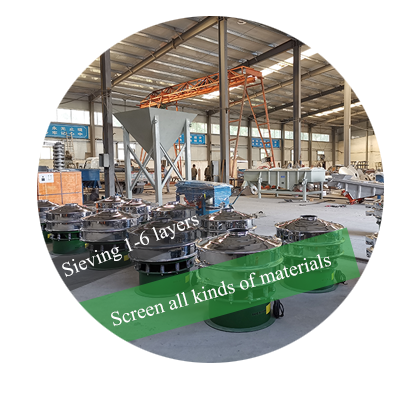
How to Choose Between a Rotary Vibrating Sieve and a Linear Screen?
Why Choosing the Right Screening Machine Matters
Selecting the wrong industrial screening equipment directly impacts your production efficiency, product purity, and long-term operational costs. While both Rotary Vibrating Sieves and Linear Vibrating Screens are essential for material separation, they are engineered for vastly different applications. That is why the decision must be deliberate: Choose Between a Rotary Vibrating Sieve and a Linear Screen based on your specific material, capacity, and process requirements. Using an improper machine can lead to frequent screen clogging, poor output quality, excessive downtime, and wasted raw materials. Understanding their fundamental differences is key to optimizing your processing line and maximizing return on investment (ROI).
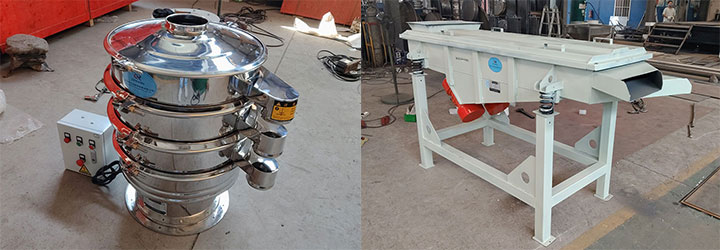
Rotary Vibrating Sieve: Ideal for high-precision screening, fine powders, ultra-fine grading, and slurry filtration (up to 500 mesh).
Linear Vibrating Screen: Built for high-capacity, heavy-duty, and coarse-to-medium particle separation (up to 200 mesh).
Overview of Rotary Vibrating Sieve and Linear Vibrating Screen
Before making a purchasing decision, it is essential to understand how each machine operates and what applications they are built for.
Rotary Vibrating Sieve: Working Principle & Features
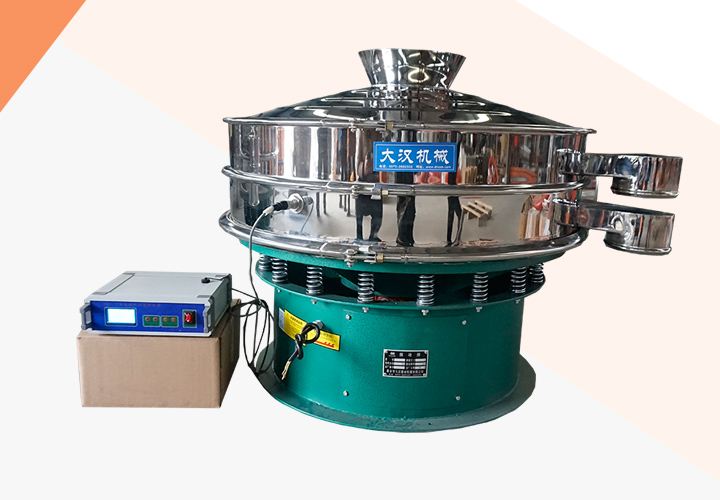
A rotary vibrating sieve (also known as a circular vibrating screen or gyratory sifter) is driven by a vertical vibration motor. The weight blocks at the upper and lower ends transform the motor's rotation into horizontal, vertical, and inclined three-dimensional (3D) motions.
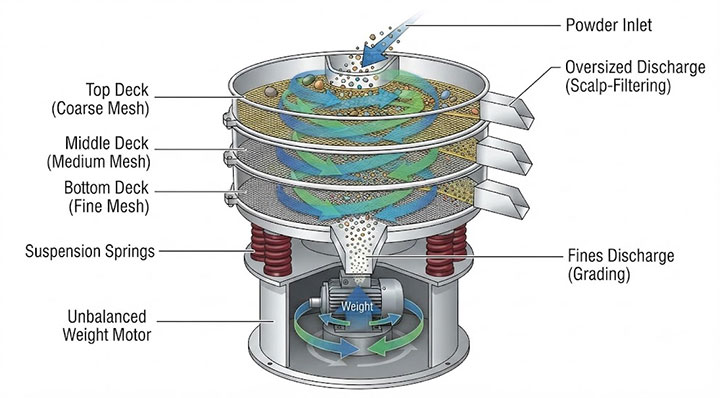
- Motion Trajectory: 3D circular motion (dispersing material from the center to the periphery).
- Core Strengths: High screening precision (up to 500 mesh), excellent for fine powders, granules, and liquids/slurries, equipped with anti-blinding devices (bouncing beads).
- Typical Applications: Chemical powders, food ingredients, pharmaceutical granules, and ceramic slurries.
Linear Vibrating Screen: Working Principle & Features
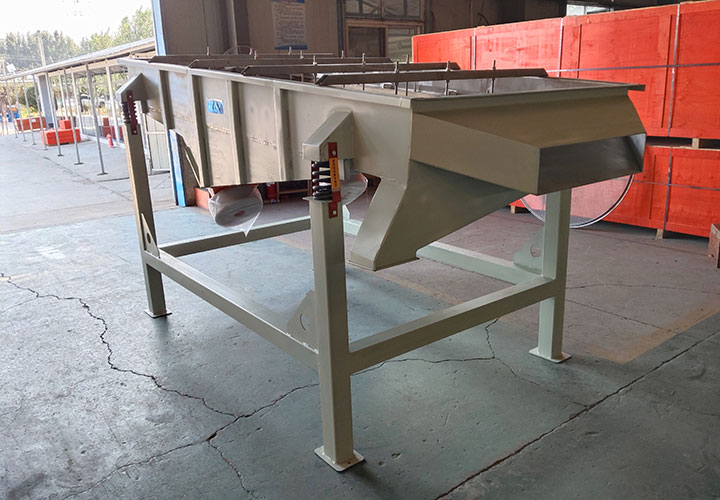
A linear vibrating screen utilizes dual vibration motors. When the two motors rotate synchronously in reverse, the exciting force generated by the eccentric blocks cancels out in the parallel direction and accumulates in the perpendicular direction, driving the material to jump forward in a straight line.
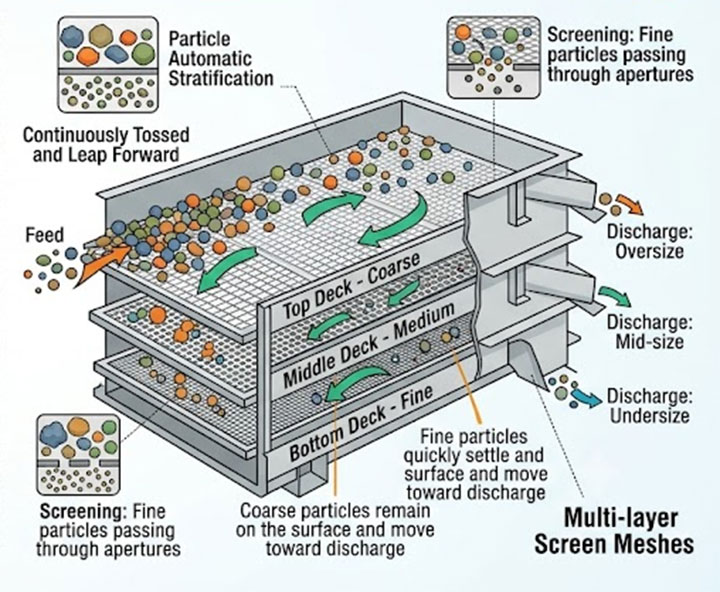
- Motion Trajectory: Straight-line linear motion (forward skipping).
- Core Strengths: Large processing capacity, high throughput for coarse materials, heavy-duty structure, and easy mesh replacement.
- Typical Applications: Mining aggregates, construction materials, dry coarse powders, abrasives, and fertilizer sizing.
Rotary Vibrating Sieve vs. Linear Vibrating Screen: Head-to-Head Comparison
To help you choose the right model based on scale and capacity, here is a specification comparison derived from our industrial product lines:
| Feature / Specification | Rotary Vibrating Sieve (DH Series) | Linear Vibrating Screen (DZSF Series) |
|---|---|---|
| Available Sizes / Dimensions | Diameter: 400mm – 1800mm (DH-400 to DH-1800) | Screening Area: 500*2000mm to 1500*3000mm |
| Layers Supported | 1–5 Layers | 1–6 Layers |
| Feeding Size / Particle Limit | < 10 mm | 0.074 – 10 mm (Mesh: 2–400 mesh) |
| Capacity Range (Output) | 100 kg/h – 2,000 kg/h (Fine grading & powders) | Up to 3 – 32 t/h (High-capacity coarse screening) |
| Motor Power | 0.18 kW – 2.2 kW (Single vertical motor) | 0.37×2 kW – 2.2×2 kW (Dual vibration motors) |
How to Choose: 5 Critical Factors for Your Selection
To determine whether a rotary sieve or a linear screen best fits your production line, evaluate the following five core factors:
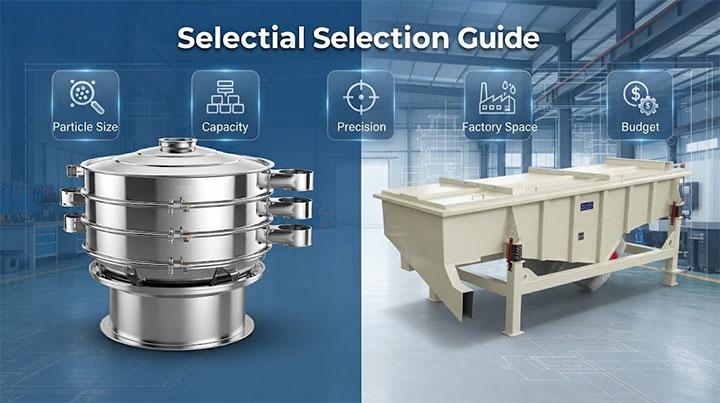
Particle Size and Material State (Dry vs. Slurry)
If your application involves liquid filtration, slurry dewatering, or ultra-fine dry powders, the 3D motion of a rotary vibrating sieve is ideal. For dry coarse particles and aggregates, a linear vibrating screen performs better.
For example, in our recent project with a chemical powder plant in Southeast Asia, switching from a linear screen to a 1000mm rotary vibrating sieve completely resolved their fine powder agglomeration issue at 300 mesh.
Required Production Capacity (Output)
Assess your hourly target. Rotary sieves typically handle smaller-to-medium volumes (100 kg/h to 2 tons/h), whereas linear screens are engineered for massive industrial outputs ranging up to 32 tons/h.
Screening Precision & Mesh Requirements
If your process demands high-precision grading up to 500 mesh, choose the rotary sieve. If you are dealing with coarse-to-medium sizing (2 to 200 mesh), the linear screen is more efficient.
Factory Space and Layout Integration
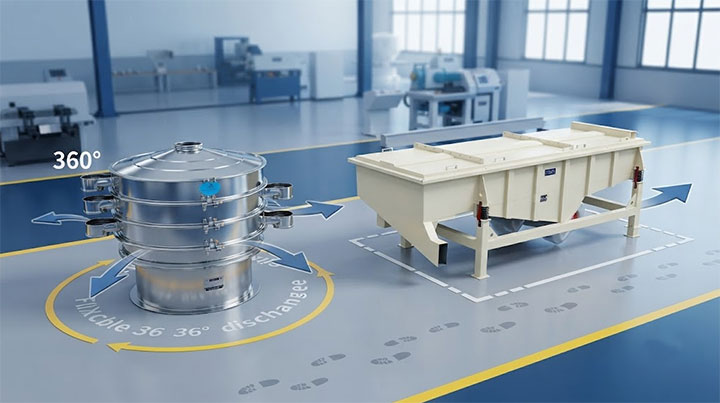
Consider your facility's footprint. Rotary models feature a compact circular design with a flexible 360-degree discharge port, while linear screens require more horizontal layout space with tail-end discharge.
Budget and Maintenance Costs
Balance your initial investment and long-term upkeep. Evaluate motor power requirements, screen replacement frequency, and ease of mesh cleaning to optimize total operating costs.
Expert Recommendations by Industry
Different industries have unique processing standards. Here is a quick guide to help you match your industry with the right screening equipment:
Chemical, Food & Pharmaceutical
Best Choice: Rotary Vibrating Sieve (DH Series)
Ideal for fine powders, food additives, pharmaceutical granules, and liquid slurries. It ensures high hygiene standards, prevents contamination, and achieves precision grading up to 500 mesh with anti-blinding devices.
Mining, Aggregates & Construction
Best Choice: Linear Vibrating Screen (DZSF Series)
Built for heavy-duty industrial environments. Best suited for high-capacity sizing, grading of coarse aggregates, abrasives, dry sands, and fertilizers with outputs reaching up to 32 t/h.
Frequently Asked Questions (FAQ)
Can a rotary vibrating sieve handle wet materials or liquid slurries?
Yes. Rotary vibrating sieves (DH Series) are exceptionally well-suited for liquid filtration and slurry dewatering, effectively removing impurities and grading wet materials.
What is the maximum mesh size a linear vibrating screen can achieve?
Linear vibrating screens (DZSF Series) are primarily engineered for coarse-to-medium sizing, typically handling mesh sizes ranging from 2 mesh up to 400 mesh, with optimal performance in high-capacity dry screening.
How can I prevent screen blinding or mesh clogging during operation?
Rotary sieves are typically equipped with bouncing cleaning devices (such as silicone balls) underneath the screen to constantly clear the mesh. For linear screens, adjusting vibration angles and utilizing proper mesh cleaning accessories helps minimize clogging.
Get a Custom Screening Solution
Choosing between a rotary vibrating sieve and a linear vibrating screen comes down to your core requirements: opt for the rotary sieve when you need high-precision grading, fine powders, or slurry filtration; choose the linear screen when your priority is massive industrial output, coarse aggregates, and heavy-duty dry screening.
Struggling to Select the Right Equipment for Your Material?
Every industrial application is unique. Share your material specs (particle size, moisture, and target capacity) with our engineering team, and we will tailor a free custom screening solution and quotation for your production line.
Request Your Free Custom Solution & Quote →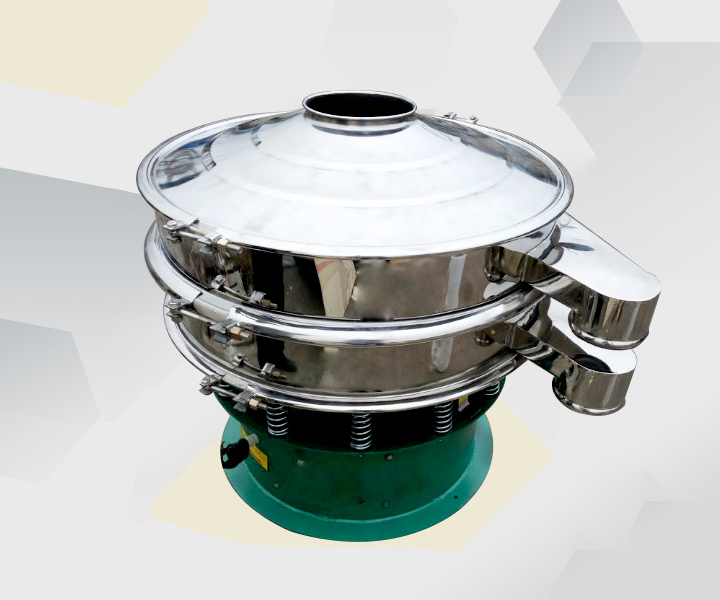
How to Calculate Vibro Sifter Capacity and Yield? Formula & Selection Guide
Calculating How to Calculate Vibro Sifter Capacity and Yield? requires more than checking screen diameter or machine specifications...
Preventing Mesh Clogging in High-Moisture Grain Screening: Practical Solutions
Screening grains with elevated moisture levels routinely triggers severe mesh blinding...
How to Choose Between Stainless Steel and Synthetic Mesh for Polymer Screening
In polymer extrusion and compounding, the screen mesh sits between the screw and the die...

Email:
sale@xxdahan.com
WhatsApp:
+86 15236742901
Add:
1000m West of Forest Park,Yanjin County,Xinxiang City,Henan Province,China.