How to Calculate Vibro Sifter Capacity and Yield? Formula & Selection Guide
Calculating How to Calculate Vibro Sifter Capacity and Yield? requires more than checking screen diameter or machine specifications. Actual screening capacity depends on effective screening area, bulk density, mesh size, particle‑size distribution, moisture content, open area, feed rate, and screening efficiency. Capacity determines how much material a vibro sifter can process per hour, while yield shows how much qualified product is recovered from the feed material. This guide explains the basic calculation methods, formulas, influencing factors, and selection parameters needed to evaluate vibro sifter performance.
Quick Answer: How Do You Calculate Vibro Sifter Capacity and Yield?
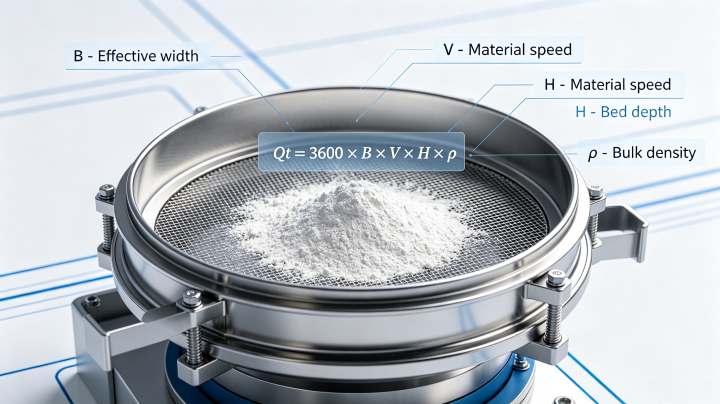
Vibro Sifter Capacity Formula
Qt = 3600 × B × V × H × ρ
| Symbol | Meaning |
|---|---|
| Qt | Theoretical throughput (kg/h) |
| B | Effective screening width (m) |
| V | Material travel speed (m/s) |
| H | Average material bed depth (m) |
| ρ | Bulk density (kg/m³) |
This formula estimates the theoretical material flow across the screening surface. For practical screening capacity, additional factors should be considered:
Qp ≈ Qt × OA × E × F
| Symbol | Meaning |
|---|---|
| Qp | Practical screening capacity |
| OA | Screen open area |
| E | Screening efficiency |
| F | Correction factor |
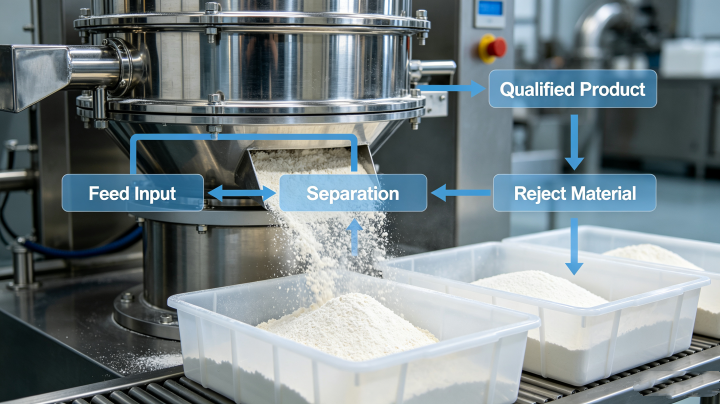
Product yield is calculated as:
Yield (%) = Qualified Product Output ÷ Feed Input × 100
These formulas are used for preliminary evaluation. Actual capacity depends on material characteristics, screen configuration, and operating conditions. Current capacity calculation methods also consider factors such as open area, efficiency, bulk density, and correction factors.
What Is Vibro Sifter Capacity?
Vibro sifter capacity refers to the amount of material processed within a specific time period, usually measured in: kg/h, t/h. However, capacity is not a fixed value. The same vibro sifter may achieve different output rates when processing different materials.
For example:
Dry granules usually have better flowability.
Fine powders may require lower loading.
Sticky materials may reduce effective screen area.
Fine mesh applications may reduce throughput.
Therefore, capacity should always be evaluated together with material properties and required separation performance.
Capacity vs Yield vs Screening Efficiency
| Item | Capacity | Yield | Screening Efficiency |
|---|---|---|---|
| Definition | Amount of material processed per hour | Amount of qualified product recovered | Accuracy of particle separation |
| Unit | kg/h or t/h | % | % |
| Main purpose | Determine production capability | Evaluate product recovery | Measure screening performance |
| Main factors | Screen area, density, feed rate | Feed composition and product requirement | Mesh size, particle distribution, operating conditions |
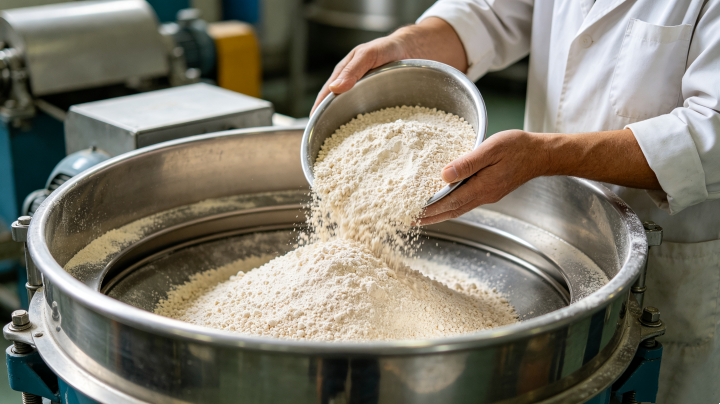
Capacity, yield, and screening efficiency are related but should not be treated as the same measurement.
How to Calculate Vibro Sifter Capacity?
The calculation process starts with estimating theoretical material flow.
Step 1: Calculate Theoretical Capacity
Qt = 3600 × B × V × H × ρ
Example:
Assume:
Effective width (B) = 1.0 m
Material speed (V) = 0.10 m/s
Bed depth (H) = 0.03 m
Bulk density (ρ) = 600 kg/m³
Qt = 6,480 kg/h
This is the theoretical material flow under the assumed conditions. For a circular vibro sifter, this formula should be considered a simplified material‑flow estimation rather than a guaranteed machine rating. Actual output depends on effective screening area, material behavior, mesh condition, and operating parameters.
Step 2: Adjust for Practical Screening Conditions
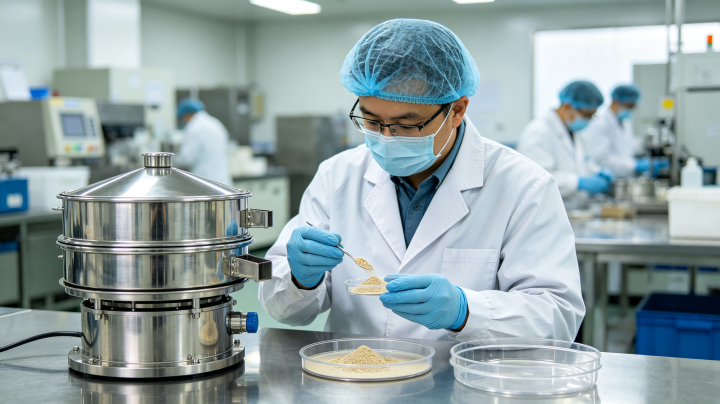
Actual capacity is usually lower than theoretical capacity because not all material will pass through the screen under real conditions. A simplified estimate is:
Qp ≈ Qt × OA × E × FExample:
Assume:
Open area = 45% (0.45)
Screening efficiency = 90% (0.90)
Correction factor = 0.80
Qp ≈ 2,099 kg/h
This result is a preliminary estimate. Actual production capacity should be verified according to the material, screen specification, and operating conditions.
Factors Affecting Vibro Sifter Capacity
Actual capacity is influenced by several factors.
| Factor | Effect on Capacity |
|---|---|
| Effective Screening Area | Larger effective area generally allows higher throughput |
| Bulk Density | Directly affects mass flow calculation |
| Mesh Size | Fine mesh may reduce open area and throughput |
| Particle Size Distribution | Near‑size particles require longer screening time |
| Moisture Content | Sticky materials may cause screen blinding |
| Feed Rate | Excessive loading reduces separation efficiency |
| Screen Open Area | Higher open area improves particle passage |
| Vibration Conditions | Affects material movement and residence time |
Effective Screening Area
Screen diameter alone does not determine capacity. Only the usable screening surface contributes to separation. Areas affected by feed distribution, support structures, or blocked mesh openings may reduce actual performance.
Bulk Density
Bulk density directly affects mass throughput. The relationship is: Mass Flow = Volume Flow × Bulk Density. Materials with different densities will have different kg/h capacities even under the same screening conditions.
Mesh Size
Mesh size determines the separation point. A finer mesh generally provides smaller openings and may reduce throughput because fewer particles can pass through at the same time.
Particle‑Size Distribution
Average particle size is not enough for capacity evaluation. The percentage of undersize particles, near‑size particles, oversize particles can significantly affect screening difficulty. Near‑size particles are especially important because they require more opportunities to pass through the mesh.
Moisture Content
Moisture can reduce screening performance. Wet or sticky materials may block openings, increase particle adhesion, reduce effective open area. For difficult materials, additional screen‑cleaning measures may be required.
How to Calculate Vibro Sifter Yield?
Yield measures how much qualified product is recovered from the feed.
Yield (%) = Qualified Product Output ÷ Feed Input × 100
Example:
Feed input: 2,000 kg
Qualified product: 1,840 kg
Yield = 92%
This means 92% of the feed becomes qualified product. However: Yield ≠ Screening Efficiency. A lower yield does not always indicate poor screening performance. If part of the incoming material does not meet the required specification, that material may correctly leave the process as reject material.
How to Select the Right Vibro Sifter Capacity?
The correct capacity should be selected according to actual production requirements.
| Parameter | Why It Matters |
|---|---|
| Material type | Determines screening behavior |
| Required capacity | Defines production target |
| Bulk density | Used for mass‑flow calculation |
| Mesh size | Determines separation requirement |
| Particle‑size distribution | Shows screening difficulty |
| Moisture content | Indicates blinding risk |
| Required yield | Defines product recovery target |
A larger machine does not always provide the best solution. The goal is to select equipment that can maintain required production rate, stable screening performance, desired product quality.
What Information Is Needed for Capacity Evaluation?
To accurately evaluate vibro sifter capacity, provide:
| Information | Purpose |
|---|---|
| Material type | Understand screening behavior |
| Required output | Determine capacity requirement |
| Bulk density | Calculate mass flow |
| Mesh size | Confirm separation target |
| Particle‑size distribution | Evaluate screening difficulty |
| Moisture content | Assess potential blinding |
| Required yield | Define product recovery goal |
Dahan recommends evaluating the complete application instead of selecting equipment only according to screen diameter or nominal capacity.
Frequently Asked Questions
Does a larger vibro sifter always have higher capacity?
No. A larger screening area can increase potential throughput, but actual capacity also depends on material properties, mesh size, moisture, particle distribution, and screening efficiency.
Can vibro sifter capacity be calculated from diameter alone?
No. Diameter only indicates part of the available screening area. Actual capacity requires evaluation of material characteristics and operating conditions.
Does finer mesh reduce vibro sifter capacity?
Usually yes. Smaller openings reduce available passage area and may increase the risk of screen blocking, especially with fine powders.
Why is actual capacity lower than theoretical capacity?
Because theoretical calculations do not include all real operating conditions, such as moisture, particle distribution, feed stability, and screen condition.
What is the most accurate way to determine capacity?
Calculation provides a preliminary estimate. Testing representative material under actual screening conditions provides a more reliable evaluation.
-
Preventing Mesh Clogging in High-Moisture Grain Screening: Practical Solutions
Screening grains with elevated moisture levels routinely triggers severe mesh blinding ...
-
How to Choose Between Stainless Steel and Synthetic Mesh for Polymer Screening
In polymer extrusion and compounding, the screen mesh sits between the screw and the die ...
-
5 Essential Tips for Selecting the Right Vibro Sifter for Fine Powders
Selecting the right vibro sifter for fine powders requires more than choosing a machine with a fine mesh or a high advertised capacity ...

Email:
sale@xxdahan.com
WhatsApp:
+86 15236742901
Add:
1000m West of Forest Park,Yanjin County,Xinxiang City,Henan Province,China.