How to Choose Between Stainless Steel and Synthetic Mesh for Polymer Screening
What Is Polymer Screening and Why Mesh Material Selection Matters
In polymer extrusion and compounding, the screen mesh sits between the screw and the die. It catches contaminants, generates back pressure for melt homogeneity, and protects downstream equipment. A simple part with three critical jobs.Choose the wrong mesh material, and you will see the symptoms quickly: pressure spikes, frequent screen changes, off-spec product, or worse, a production halt. So when you choose between stainless steel and synthetic mesh, it’s not about preference—it’s about what your process actually demands.
This guide walks through the material properties, process parameters, and practical trade-offs. The goal: help you match the mesh to your actual production conditions, not just the price sheet.
Understanding Polymer Screening Mesh: Basics You Need to Know
What Is a Polymer Screening Mesh?
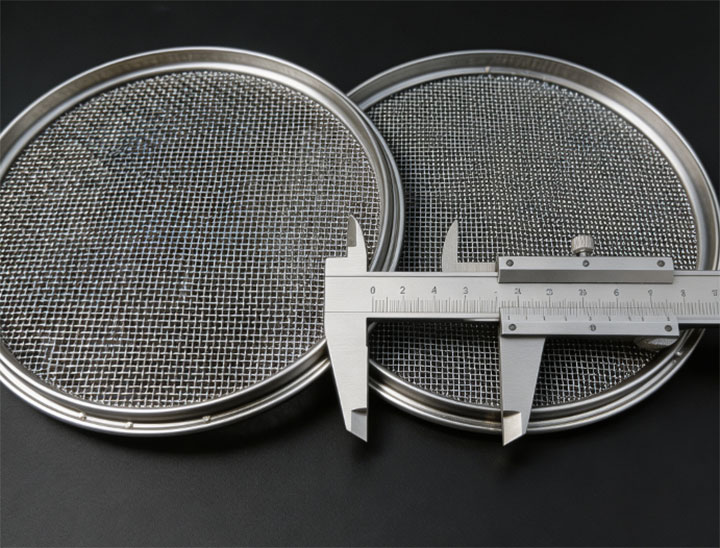
A screen mesh sits inside the extruder, right before the die. It is a metal or synthetic fabric disc that does three things: stops solid contaminants from reaching the die, creates back pressure to improve melt uniformity, and supports the breaker plate.Mesh material matters because the polymer melt sees both heat and shear. If the mesh cannot handle the conditions, it fails. And when it fails, you lose all three functions at once.
Key Mesh Specifications: Mesh Count and Micron Rating
Mesh count is the number of openings per linear inch. A 100-mesh screen has 100 openings in one inch. Higher count means smaller openings and finer filtration.Micron rating is the actual opening size in micrometers. It tells you what particle size the screen can catch. A 100-mesh screen typically has about 150-micron openings, but the exact value depends on wire diameter and weave style.
These two numbers describe the same thing from different angles—mesh count tells you the density, micron tells you the particle size. For polymer screening, both matter. Count dictates flow resistance, micron dictates filter quality.
Stainless Steel vs. Synthetic Mesh: Material Properties Compared
Stainless Steel Mesh: Properties, Advantages and Limitations
Stainless steel mesh is drawn from wire, woven, and then set. Common grades are 304, 316, and 316L. The difference: alloy content. 316L has more molybdenum, which improves corrosion resistance in acidic or chloride-rich polymer streams.
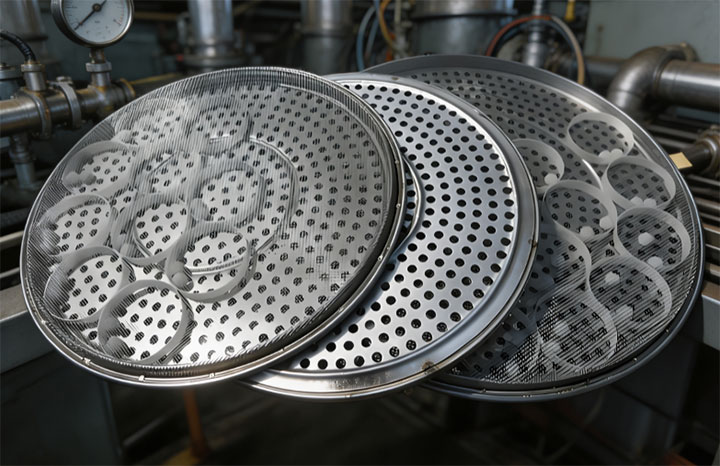
What stainless steel does well: it holds its shape under heat and pressure. A 100-mesh stainless screen at 300°C has the same openings as it does at room temperature. It handles continuous operation at 500°C+ in 316L grade. It resists most chemicals used in polymer processing, including PVC degradation byproducts. And it survives high-pressure cleaning—100 bar water or ultrasonic baths—without losing dimensional accuracy.
The limitation: upfront cost. Stainless costs more per screen than synthetic. But the question is whether the longer service life offsets that cost. In most continuous production lines, it does.
Synthetic Mesh: Properties, Advantages and Limitations
Synthetic mesh is made from polymer fibers—nylon (polyamide), polypropylene (PP), or polyester (PET). Each has distinct chemical resistance: PP handles acids well but oxidizes; nylon resists oils but dissolves in strong acids. No single synthetic covers all chemistries.
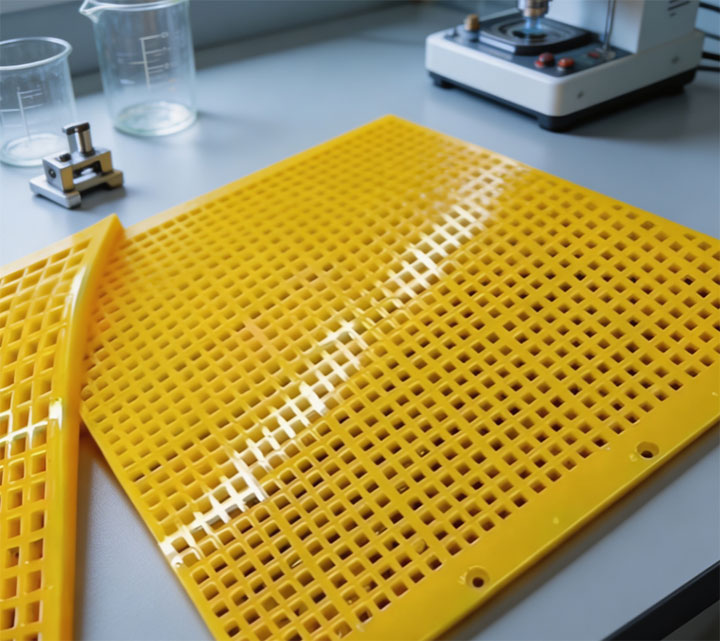
The advantages are real for the right application. Synthetic mesh is lightweight, flexible, and costs a fraction of stainless. For short runs, trial batches, or low-temperature processes (below 100°C), it does the job at a lower entry price.
But the downsides are sharp. Temperature is the first limit—nylon softens around 110°C, PP at 120°C, PET at 150°C. Above these, the mesh loses strength and deforms. Pressure is the second—synthetic fibers stretch under load, changing the opening size and filtration consistency. And cleaning is limited—high-pressure water tears the weave, so most synthetics are single-use.
Head-to-Head Comparison: Key Performance Parameters
This table summarizes the critical differences between stainless steel and synthetic mesh across the parameters that directly impact polymer screening performance.
| Parameter | Stainless Steel Mesh | Synthetic Mesh |
|---|---|---|
| Maximum operating temperature | 500°C+ (316L grade) | 100–150°C (varies by material) |
| Mechanical strength | High — holds shape under load | Moderate — stretches under pressure |
| Chemical resistance | Excellent across most polymers | Material-dependent — no universal option |
| Filtration stability | Stable — openings remain consistent | Varies — fibers deform under load |
| Pressure drop behavior | Predictable and steady | Rises sharply as mesh deforms |
| High throughput suitability | Yes — maintains integrity at >500 kg/h | Limited — fatigue and wear at high flow |
| Cleaning tolerance | High — withstands >100 bar water jet | Low — tears easily under pressure |
| Reusability | 3–5 cleaning cycles | Typically single-use |
| Initial cost per screen | Higher | Lower |
| Long-term operating cost | Lower — fewer replacements | Higher — frequent change-outs |
| Environmental impact | 100% recyclable | Industrial waste after each use |
How Key Process Parameters Influence Mesh Material Selection
Material data sheets tell one story. Process conditions tell another. Here is how four key parameters affect each mesh type in actual production.
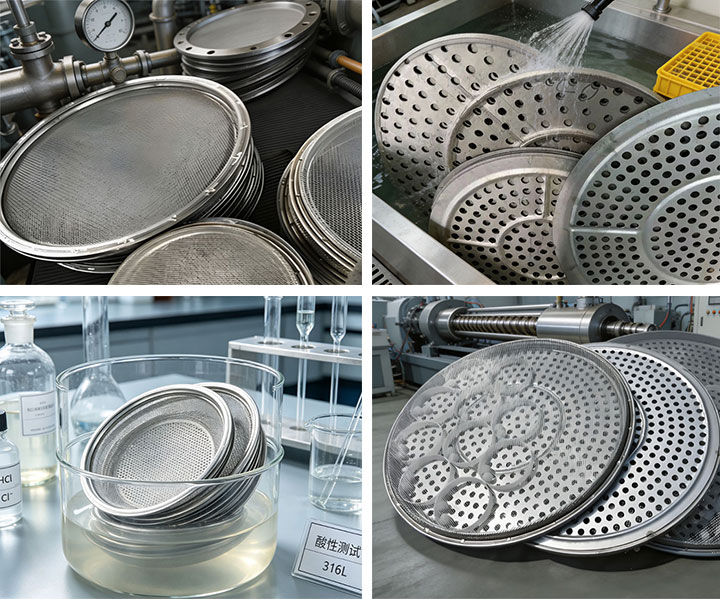
Pressure Drop (ΔP) — How Mesh Material Affects Flow Resistance
Pressure drop is the resistance the melt encounters as it passes through the screen. In extrusion, stable pressure means stable output.
Stainless steel delivers that stability. The rigid wire structure keeps openings consistent regardless of pressure. Set it once, it stays. Synthetic mesh behaves differently. As pressure builds, the polymer fibers stretch and openings deform. Resistance changes mid-run, pressure drifts. You adjust. It drifts again. You chase the setpoint instead of running the process.
Throughput Capacity — Performance Under High-Volume Processing
Throughput is where stainless steel separates itself from synthetic. At low rates, both work. At industrial rates, the gap widens.
Stainless handles high melt flow without fatigue. Larger wire diameter, higher mechanical strength—it maintains filtration efficiency above 500 kg/h. Synthetic was not built for that load. Fibers fatigue under continuous shear. The weave loosens. Filtration drops. Replacement intervals shorten.
Cleaning Pressure and Regeneration — Reusability Considerations
Cleaning is where the cost difference between the two materials becomes clear.
Stainless goes into a cleaning station, gets high-pressure water or ultrasonic bath, and comes out ready for another run. Three to five cycles is typical. Synthetic cannot take that. The fibers tear under pressure. The weave distorts. For most processors, it is single-use.
Chemical Compatibility Under Process Conditions
Chemical resistance is not just about the polymer melt. It is about additives, degradation products, and cleaning agents that contact the screen.
Stainless 316L covers most polymer processing chemistries—acidic streams, chlorinated compounds, PVC degradation byproducts. Synthetic has narrower tolerance. PP resists acids but oxidizes. Nylon handles oils but dissolves in strong acids. Polyester sits in between. No universal option. Every material change requires a compatibility check.
How to Choose: Application-Based Selection Guide
Material properties matter, but the final decision always comes down to your specific process. Here is when each mesh type makes sense.
When to Choose Stainless Steel Mesh for Polymer Screening
Stainless steel is the default choice for most industrial polymer processing. It fits these conditions:
- High-temperature polymers — PET, PA66, PC, PPS. Any process above 150°C rules out synthetics.
- Corrosive polymers — PVC, fluoropolymers, or any resin that releases acidic byproducts. 316L is the safe bet.
- Continuous production — Long runs where screen changes cost downtime. Stainless lasts longer.
- High-pressure systems — Extruders running above 100 bar. Stainless holds its shape.
- When filtration consistency is critical — Tight product specifications demand stable openings over time.
When to Choose Synthetic Mesh for Polymer Screening
Synthetic mesh has a narrower window but performs well within it. Consider synthetics for:
- Low-temperature processes — Below 100°C. Examples: some PE and PP grades, cold compounding.
- Short production runs — Pilot lines, trials, or R&D batches where long life is unnecessary.
- Single-use applications — When cleaning is not practical or cost-effective.
- Non-corrosive, clean polymers — Virgin resins without fillers or additives that stress the screen.
Polymer Type and Mesh Material Matching Guide
Use this quick reference for common polymers:
| Polymer | Recommended Mesh | Reason |
|---|---|---|
| PET | Stainless steel (316L) | High melt temperature (260–280°C) |
| PA66 (Nylon) | Stainless steel (316L) | High temperature, moisture sensitivity |
| PC (Polycarbonate) | Stainless steel (316L) | High temperature, moisture-sensitive |
| PVC | Stainless steel (316L) | Corrosive — releases HCl at processing temperature |
| PPS | Stainless steel (316L) | Very high temperature (280–300°C) |
| PE (standard grades) | Either — depends on temperature | Below 100°C: synthetic possible. Above: stainless |
| PP (standard grades) | Either — depends on temperature | Below 100°C: synthetic possible. Above: stainless |
| Fluoropolymers (PTFE, FEP) | Stainless steel (316L) | Highly corrosive — requires 316L |
| Clean virgin pellets | Synthetic (short runs) or stainless (long runs) | Material choice depends on run length |
Stainless Steel vs. Synthetic Mesh: Complete Comparison at a Glance
This table consolidates every comparison point from this guide into one reference. Use it for quick decisions or as a summary before purchasing.
| Parameter | Stainless Steel | Synthetic |
|---|---|---|
| Temperature limit | 500°C+ | 100–150°C |
| Pressure stability | Stable — consistent openings | Deforms — pressure drifts |
| Throughput capacity | High (>500 kg/h) | Limited — fatigue at high flow |
| Chemical resistance | Broad (316L handles most) | Narrow — check each polymer |
| Cleaning tolerance | High (>100 bar water jet) | Low — tears easily |
| Reusability | 3–5 cycles | Single-use |
| Initial cost | Higher | Lower |
| Long-term cost | Lower | Higher |
| Best for | Continuous production, high temp, corrosive polymers | Short runs, low temp, lab trials |
| Environmental | 100% recyclable | Industrial waste |
Optimizing Your Screen Pack Configuration
Choosing the right mesh material is one part. Configuring the screen pack correctly is the other. Here is how weave patterns and layer arrangement affect performance.
Understanding Weave Patterns: Square Weave vs. Dutch Weave
Square weave has the same wire count in both directions. Openings are square and uniform. It is the standard for most polymer screening, especially when throughput and pressure drop are the primary concerns.
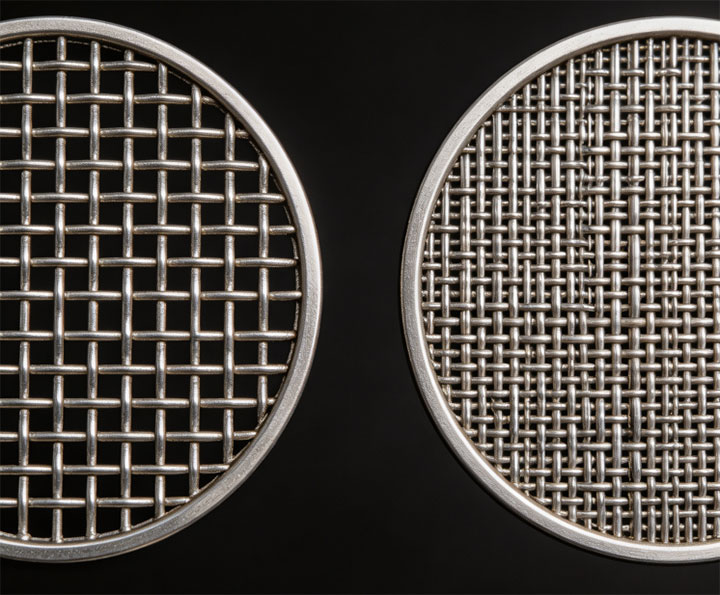
Dutch weave uses a finer warp and thicker weft. The openings are smaller and staggered, capturing finer particles than a square weave of the same mesh count. The trade-off is higher flow resistance. Use Dutch weave when filtration precision matters more than throughput.
Building the Optimal Screen Pack: The Progressive Layering Strategy
A single screen does not do everything well. The standard approach is a three-layer progressive arrangement:
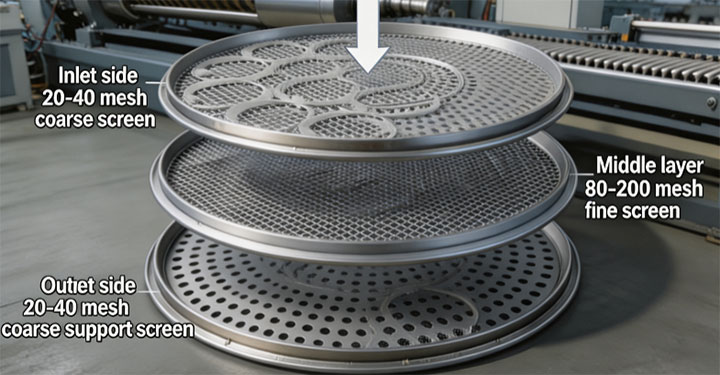
- Coarse layer (inlet side) — 20 to 40 mesh. Catches large contaminants. Protects the finer screens downstream from premature clogging.
- Fine layer (middle) — 80 to 200 mesh. The main filtration stage. Removes particles that pass the coarse screen.
- Coarse layer (outlet side) — 20 to 40 mesh. Supports the fine screen. Prevents it from bulging or tearing under pressure.
The logic is simple: coarse catches the big debris, fine filters the small particles, coarse holds everything in place. This arrangement extends screen life, stabilizes pressure, and delivers consistent melt quality.
Some processors add a fourth layer or vary the counts based on polymer type and contamination level. The principle remains the same — protect the fine screen and let it do the filtration work.
Quick Decision Framework: Stainless Steel or Synthetic Mesh?
Use this decision path to narrow down your choice in under one minute. Answer each question and follow the recommendation.
Step 1: Is your melt temperature above 120°C?
- Yes → Eliminate synthetic. Go to Step 2.
- No → Proceed to Step 2.
Step 2: Is your polymer corrosive (PVC, fluoropolymers, acid-forming resins)?
- Yes → Choose stainless steel 316L. No further questions.
- No → Proceed to Step 3.
Step 3: Is this continuous industrial production or short-run / lab work?
- Continuous industrial → Choose stainless steel. Lower long-term cost wins.
- Short-run / lab → Proceed to Step 4.
Step 4: Will you clean and reuse the screen, or discard after each run?
- Reuse → Choose stainless steel.
- Discard → Choose synthetic mesh — lower upfront cost, works for single-use.
If your answers are mixed or your process has unusual conditions, contact us with your process details. We will recommend a custom configuration.
Frequently Asked Questions About Polymer Screening Mesh
Can synthetic mesh be used for high-temperature polymer filtration?
No. Synthetic fibers soften and deform above 100–150°C. For PET, PA66, PC, or any process above 150°C, use stainless steel.
Is stainless steel mesh more expensive than synthetic mesh overall?
Higher upfront, lower long-term. Stainless lasts longer and reuses 3–5 times. Synthetic costs less per screen but needs frequent replacement. Which works out cheaper depends on your run length.
Can I use synthetic mesh for PVC filtration?
Not recommended. PVC releases corrosive HCl at processing temperature. Use 316L stainless steel.
Not sure which mesh fits your process? Send us your polymer type, temperature, and throughput — we will recommend the right screen pack.

Email:
sale@xxdahan.com
WhatsApp:
+86 15236742901
Add:
1000m West of Forest Park,Yanjin County,Xinxiang City,Henan Province,China.