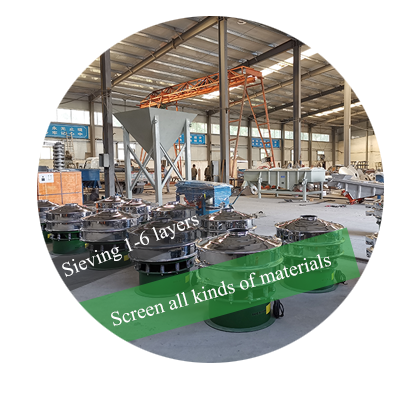
Swing Vibrating Screen
![[field:title/]](/uploads/260912/6-26091215240Gb.jpg)


Callback
The Swing Vibrating Screen is an advanced screening machine specifically engineered for large-scale, high-precision grading and multi-layer separation.
Screening Mesh: 2 – 500 Mesh
Output Capacity: 0.5 – 60 Tons/Hour
Eccentricity (Stroke): 25 – 60 mm
Drive Speed: 120 – 260 RPM
Material Options: Carbon Steel, Stainless Steel (SUS304/316L)
Layer Capacity: Up to 10 Decks Simultaneously
Application Range: Fine chemicals, new materials, food additives, pharmaceuticals, metallurgy, abrasives, and mineral processing.
Applicable Materials: Machine-made sand, silica sand, plate sand, quartz sand, ceramsite sand, calcite, calcium carbonate, bentonite, petroleum coke, flour, starch, and various dry or fine powders.
Swing Vibrating Screen: High-Precision Multi-Layer Separation
A Swing Vibrating Screen (also known as a reciprocating or gyratory screen) is an advanced high-precision screening equipment designed to solve common challenges such as low screening precision, severe mesh blinding, and rapid screen wear.Unlike traditional violent vibratory sifters, a swing screen simulates the gentle, high-efficiency motion of manual sifting by combining circular and parabolic trajectories. This low-speed, high-accuracy operation achieves up to 95% to 99% screening efficiency while protecting fragile particle structures, making it an ideal choice for fine chemicals, food additives, pharmaceuticals, and various powders.
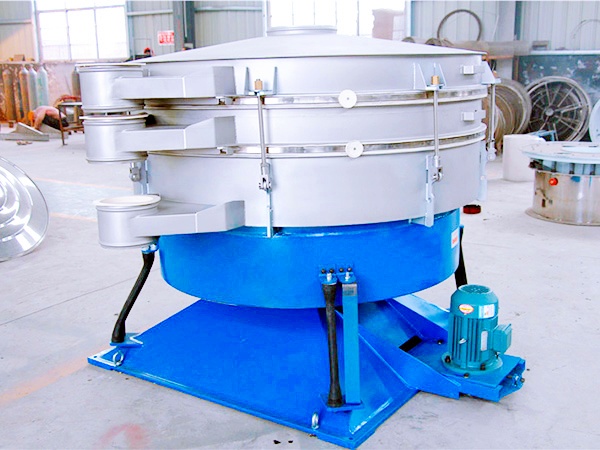
Swing Vibrating Screen vs. Standard Vibrating Screen: Key Differences
Choosing the right screening machinery depends heavily on your material properties, required precision, and output goals. A Swing Vibrating Screen differs fundamentally from standard high-frequency vibrating screens in its motion mechanics, material protection, and lifespan.
|
Features |
Swing vibrating screen |
Vibrating screen |
|
Working principle |
Imitating manual screening, low-speed swing motion |
High-frequency vibration generated by vibration motor |
|
Image |
|
|
|
Movement mode |
Plane swing, rotational motion |
Up and down vibration or three-dimensional vibration |
|
Screening efficiency |
High, suitable for fine materials |
High, suitable for large-scale coarse screening |
|
Material handling |
Gentle, suitable for fragile and sticky materials |
Very violent, suitable for hard and non-fragile materials |
|
Noise level |
Low, stable operation |
High, vibration produces large noise |
|
Screen life |
Long, due to uniform force |
Short, easy to wear due to high-frequency vibration |
|
Applicable scenarios |
Fine industries such as food, medicine, and chemicals |
Heavy industries such as mining, building materials, and metallurgy |
|
Maintenance cost |
Low, simple structure |
High, vibrating parts are easy to wear |
|
Output |
Medium and low output, focus on quality |
High output, focus on efficiency |
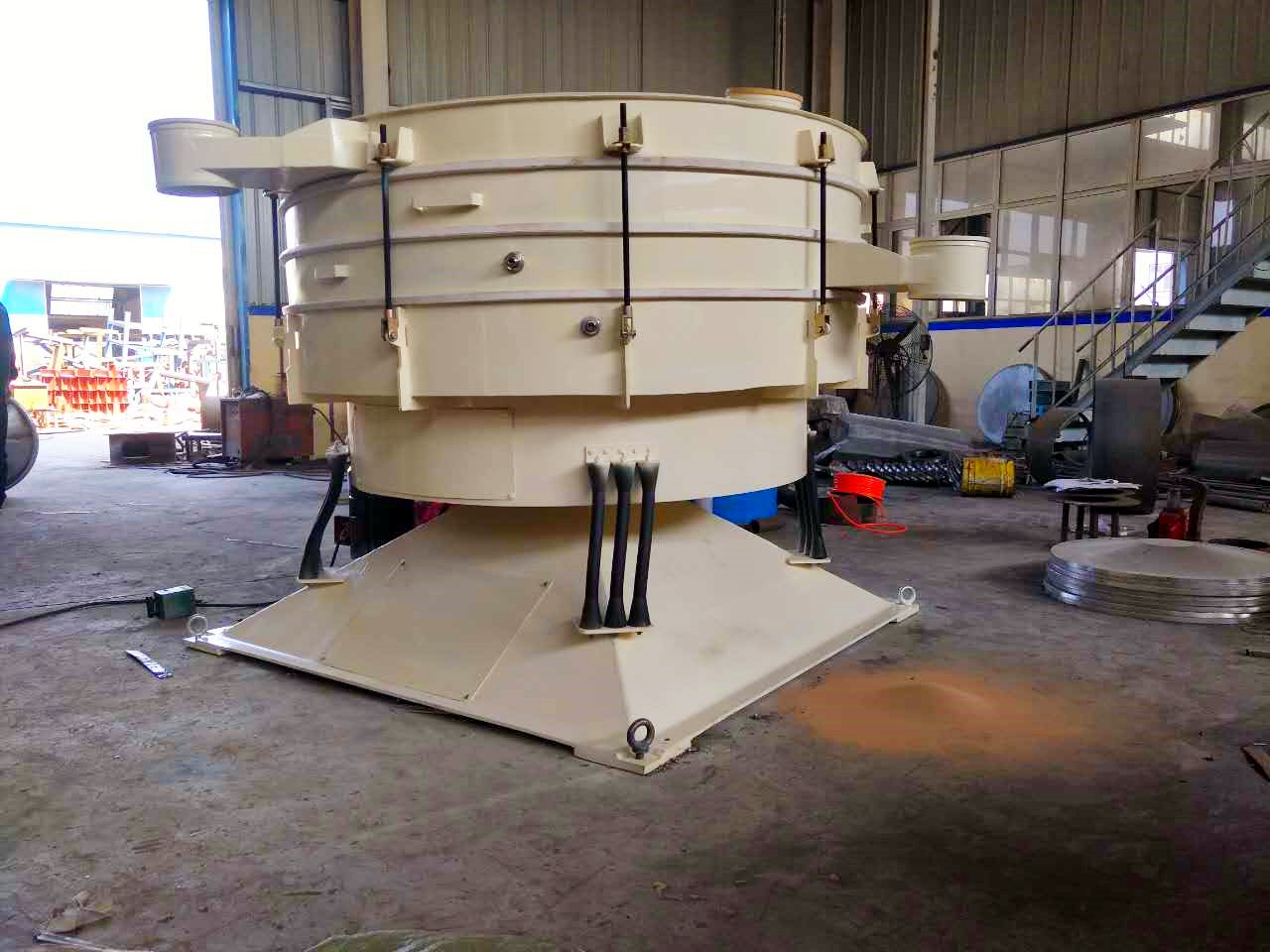
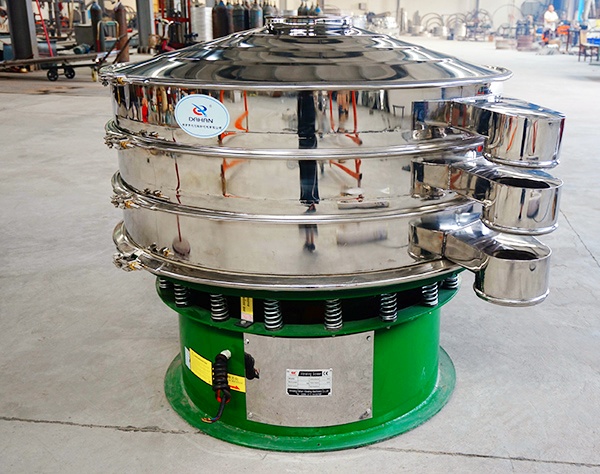
Opt for a Swing Vibrating Screen when your application demands strict particle sizing, high multi-layer grading accuracy, or protection for fragile and sticky materials. Conversely, choose a standard vibrating screen when raw processing speed and heavy load capacity take precedence over fine separation precision.
How Does a Swing Vibrating Screen Work?
The operation of a Swing Vibrating Screen mimics the kinematics of manual sifting enhanced by modern engineering. Once the drive motor starts, the screen box performs a complex composite movement consisting of a horizontal circular motion coupled with an upward parabolic trajectory.
As materials feed onto the center of the top deck, they rapidly disperse across the entire mesh surface in a smooth, three-dimensional tumbling spiral. Fine particles immediately encounter and drop through the apertures, while oversize particles travel continuously toward the outer discharge ports. This regulated residence time and uniform particle distribution eliminate dead zones and ensure ultimate separation clarity.
Swing Vibrating Screen Operational Videos
Watch the multi-layer classification and gentle material flow in action:
Main Types of Swing Vibrating Screens
Depending on the structural framework and motion dynamics, a Swing Vibrating Screen is generally classified into circular and square (or rectangular) configurations:
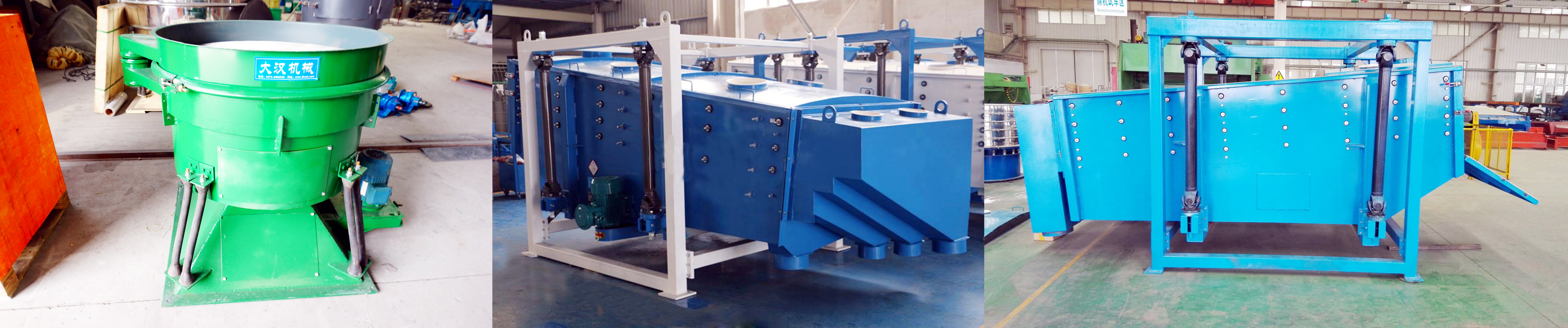
- Circular Swing Screen: The screen deck exhibits a 360-degree circular planar swing. It delivers supreme separation precision (often 93% to 95%+) for ultra-fine powders, light materials, and multi-deck grading.
- Square / Rectangular Swing Screen: Features a reciprocating linear-to-gyratory motion across a broad rectangular layout, providing significantly higher processing throughput for large-volume materials.
| Type | Shape | Motion Mode | Target Materials | Key Advantage | Main Industries |
|---|---|---|---|---|---|
| Circular Swing Screen | Circular | 360° Gyratory Swing | Ultra-fine powders & light substances | Simulates manual sifting, ultra-high accuracy | Fine chemicals, pharmaceuticals, food |
| Square Swing Screen | Rectangular / Square | Reciprocating swing | Large particles & bulk aggregates | Massive throughput capacity | Minerals, metallurgy, grain, sand |
Structures of Swing Vibrating Screen
A standard Swing Vibrating Screen is robustly engineered with several key mechanical components designed to ensure smooth operation and long-term durability:
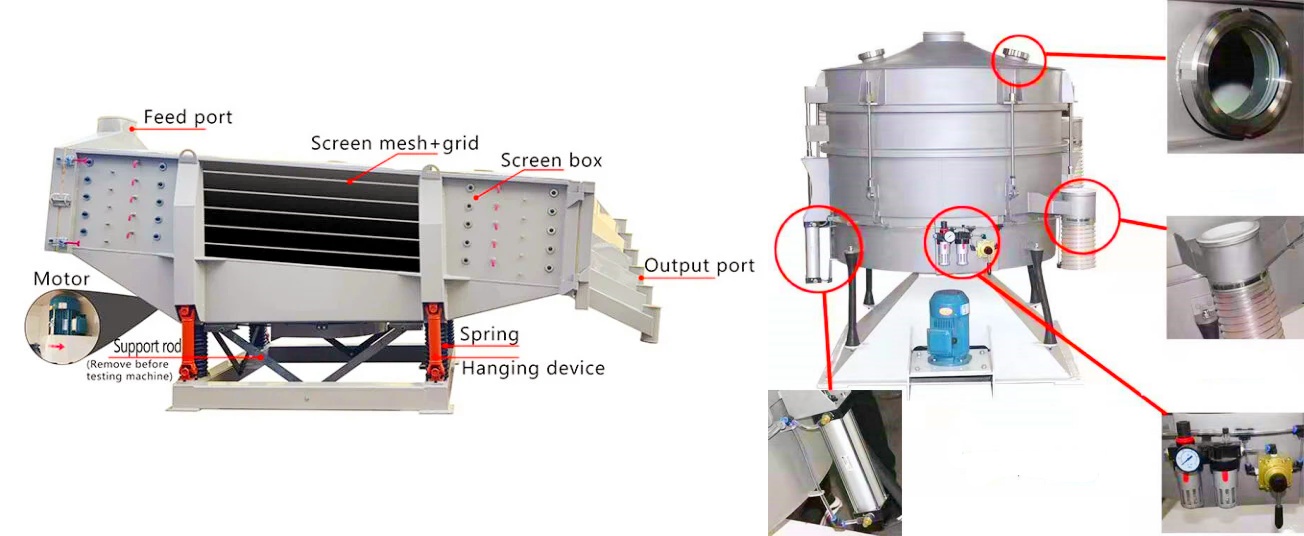
Feed Port: Directs raw materials evenly onto the center of the top screen deck.
Screen Box: The core containment frame housing multiple layered mesh frames.
Drive Device: Precision motor and eccentric mechanism that generates the tailored gyratory swing motion.
Screen Frames: Interlocking decks holding the precision woven or perforated mesh screens.
Support Frame & Base: Heavy-duty structural foundation providing overall equipment stability.
Vibration Reduction Devices: Heavy-duty industrial springs or dampeners that isolate operational vibrations from the ground.
Discharge Ports: Separate outlets designed for graded materials of different particle sizes.
Technical Specifications & Reference Models
The following table outlines standard parameters for typical Swing Vibrating Screen setups. Custom deck layouts and power configurations are available upon request:
| Model | Screen Size | Screening Area | Decks / Layers | Power (kW) | Speed (RPM) | Case Travel (Stroke) |
|---|---|---|---|---|---|---|
| DH1536 | 1.5 × 3.5 m | 4.5 – 9 m² | 1 – 10 Layers | 5.5 | 180 – 260 | 25 – 60 mm |
| AH2040 | 2.0 × 4.0 m | 8 – 9 m² | 1 – 10 Layers | 7.5 | 180 – 260 | 25 – 60 mm |
Recommended Mesh Range for Various Materials
To maximize filtering efficacy and eliminate clogging on a Swing Vibrating Screen, selecting the appropriate mesh count is essential:
| Material Type | Recommended Mesh Range | Operational Notes |
|---|---|---|
| Flour, Starch, Food Ingredients | 60 – 200 Mesh | Fine sifting with anti-agglomeration bouncing beads |
| Herbal Powder, Additives | 80 – 300 Mesh | Precision separation for pharmaceutical standards |
| Chemical Powders (Calcium Carbonate, etc.) | 100 – 400 Mesh | High particle uniformity requirements |
| Quartz Sand, Metal Powders | 10 – 200 Mesh | Suitable for both coarse sizing and fine filtering |
| Plastic Granules, Rubber Powder | 10 – 80 Mesh | Stable grading without thermal deformation |
Key Advantages of a Swing Vibrating Screen
Engineered to outperform traditional high-frequency sifting machines, a Swing Vibrating Screen provides distinct operational and economic benefits across various industrial applications:
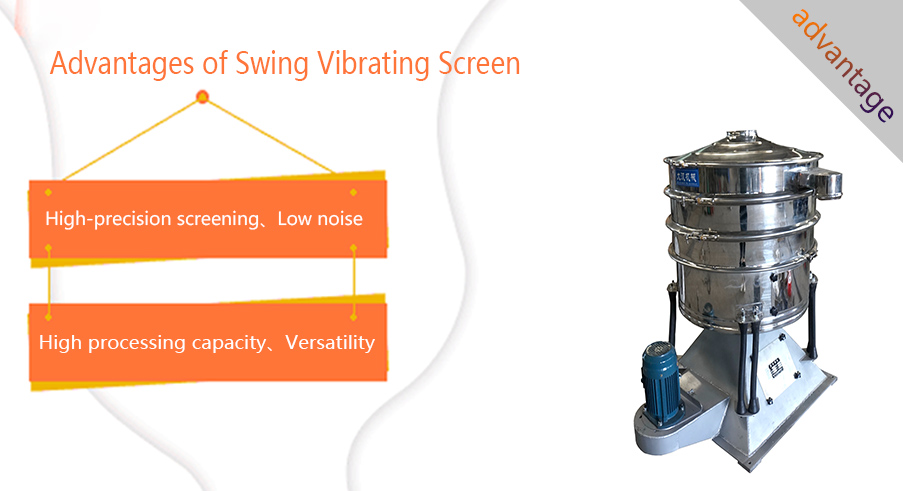
Ultra-High Screening Precision: The simulated manual gyratory motion ensures full rolling and layer-by-layer distribution of materials across the entire mesh.
Massive Throughput & Multi-Deck Capability: Supports up to 10 layers simultaneously, separating multiple particle specifications in a single pass.
Low Operation Noise & Energy Efficiency: Balanced weight distribution and robust shock absorption keep operational noise well below standard threshold limits.
Extended Screen & Mesh Life: Gentle acceleration prevents premature wear and tear on both the mesh fabrics and structural joints.
Maintenance and Operational Guidelines
To ensure peak performance and longevity for your Swing Vibrating Screen, follow these essential maintenance protocols:
Power Safety: Always lock out and disconnect the main power supply before performing any inspection or troubleshooting.
Regular Component Checks: Periodically inspect screen frames, tension springs, clamping bands, and bearing housings for wear.
Scheduled Lubrication: Apply high-grade industrial grease to drive bearings at recommended operational intervals.
Post-Run Cleaning: Clear residual powders and blockages from the mesh surface after completing daily production cycles.
Frequently Asked Questions (FAQ)
What materials are suitable for a Swing Vibrating Screen?
It is ideal for fine chemicals, food additives, pharmaceuticals, and various dry or sticky powders that require high precision and gentle handling.
How many decks can a swing screen support simultaneously?
A swing vibrating screen supports up to 10 layers simultaneously, allowing you to separate multiple particle specifications in a single pass.
How does it prevent mesh blinding during fine powder screening?
It utilizes low-speed gyratory motion combined with optional anti-agglomeration devices like bouncing beads or ultrasonic systems to keep the mesh clean.
Get Your Custom Swing Screen Solution & Factory-Direct Pricing
Get professional engineering support, custom deck configurations, free material testing analysis, and factory-direct pricing for your Swing Vibrating Screen project.


-
Swing Vibrating Screen Screening Petroleum Coke Powder
Swing Vibrating Screen Screening Petroleum Coke Powder has equipment types such as square swing vibra ...
-
Diamond Vibrating Screen
Diamond vibrating screen is a device used for screening and grading diamond particles. Through vibration force and screen structure ...
-
Centrifugal screening machine
Centrifugal screening machine is designed and produced for screening problems such as light materials, easy agglomeration, low melting point, ...
-
Sugarcane Juice Bioethanol Vibro Sifter
Sugarcane Juice Bioethanol Vibro Sifter is a device for filtering sugarcane juice, mainly used for sugarcane juice filtration in bioethanol industry. ...

Email:
sale@xxdahan.com
WhatsApp:
+86 15236742901
Add:
1000m West of Forest Park,Yanjin County,Xinxiang City,Henan Province,China.