Sieve Calibration Grades: Compliance vs. Inspection vs. Calibration Under ASTM E11-24
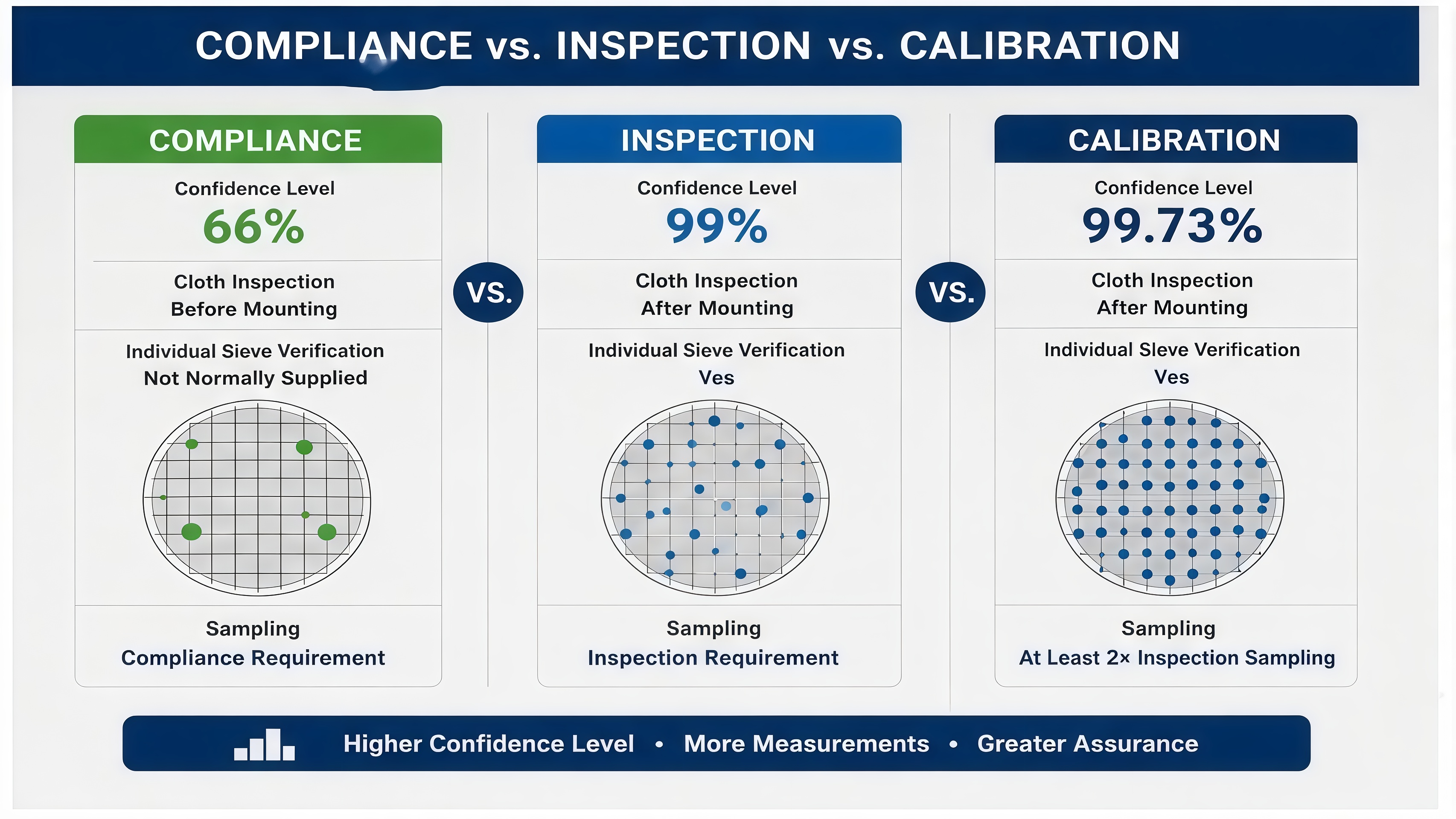
Sieve calibration is not simply a process of making a test sieve “more accurate.” Under ASTM E11-24, Compliance, Inspection, and Calibration Test Sieves represent different levels of statistical verification for sieve openings.ASTM E11-24 defines three sampling confidence levels: 66% for Compliance, 99% for Inspection, and 99.73% for Calibration. Calibration Test Sieves also require at least twice as many measured openings as Inspection Test Sieves. ASTM E11-24
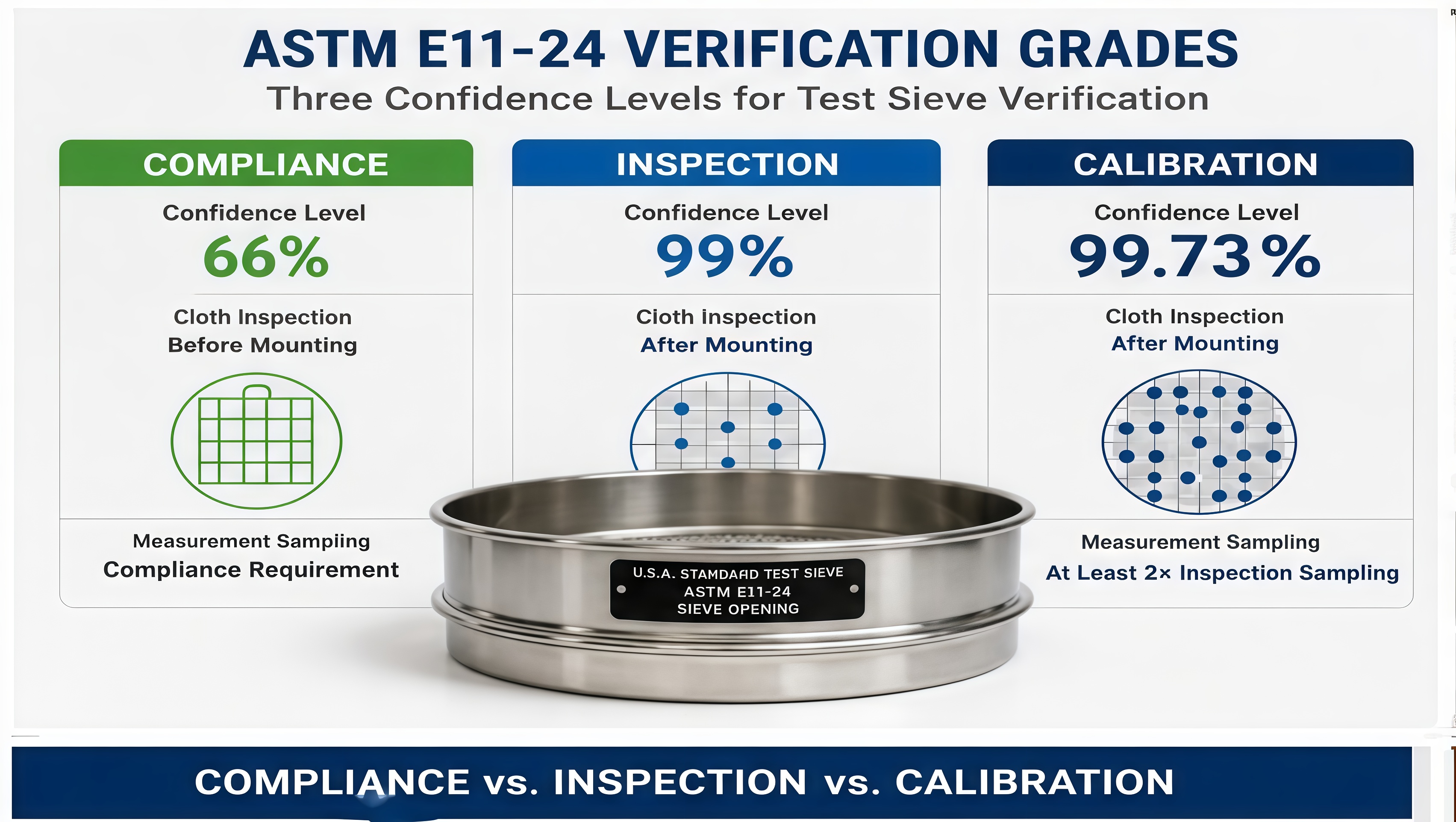
These are verification levels rather than simple low, medium, and high quality grades. The appropriate level depends on the applicable test method, customer specification, laboratory quality system, and documentation requirements.
Compliance vs. Inspection vs. Calibration: At a Glance
| Feature | Compliance | Inspection | Calibration |
|---|---|---|---|
| Confidence level | 66% | 99% | 99.73% |
| Cloth inspection | Before mounting | After mounting | After mounting |
| Individual sieve verification | Not normally supplied | Yes | Yes |
| Measurement sampling | Compliance requirement | Inspection requirement | At least twice Inspection sampling |
| Typical use | Routine testing | QC and documented testing | Higher-confidence testing |
What Is Sieve Calibration?
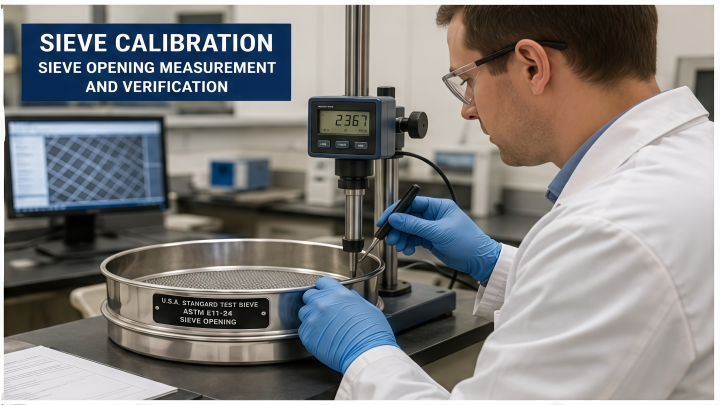
Sieve calibration involves measuring and evaluating sieve openings against the applicable specification. For particle size analysis, opening characteristics can affect test results, making the verification grade important when individual measurement data or higher statistical confidence is required.
Calibration Grade should not be confused with a calibration service performed on a used sieve. Calibration Grade is an ASTM E11 verification level, while reverification is a subsequent check of a sieve that has already been used.
What Is a Compliance Test Sieve?
A Compliance Test Sieve meets the Compliance requirements of ASTM E11-24. The sieve cloth is inspected before it is mounted into the individual sieve frame using the Compliance confidence level.
Compliance does not mean that the sieve is unverified. It meets the applicable requirements without the individual sieve measurement documentation associated with Inspection or Calibration grades, making it suitable for routine testing when no higher verification level is specified.
What Is an Inspection Test Sieve?
An Inspection Test Sieve is verified after the sieve cloth has been mounted in the frame. ASTM E11-24 specifies a 99% confidence level for Inspection Test Sieves.The assembled sieve is individually examined using the sampling and measurement requirements specified by the standard.Inspection Grade is useful when a laboratory needs individual sieve verification for quality control, repeatability, documented testing, or customer requirements.
What Is a Calibration Test Sieve?
A Calibration Test Sieve uses a 99.73% confidence level, the highest of the three ASTM E11-24 verification levels.Calibration also requires at least twice as many measured openings as Inspection. The larger measurement sample provides the higher confidence level specified by ASTM E11-24.
Calibration Grade can be appropriate when a higher statistical verification level or more extensive individual sieve data is required. It is not simply a different type of mesh; the primary distinction is the verification and statistical sampling applied to the individual sieve.
Inspection vs. Calibration: What Is the Difference?
The key difference is therefore the statistical confidence level and measurement sampling, not a different type of sieve mesh.
| Item | Inspection | Calibration |
|---|---|---|
| Confidence level | 99% | 99.73% |
| Sieve cloth inspection | After mounting | After mounting |
| Measured openings | ASTM E11 requirement | At least twice Inspection sampling |
| Typical purpose | Individual sieve verification | Higher-confidence verification |
Calibration Grade vs. Sieve Reverification
Calibration Grade and reverification are not the same.A new Calibration Test Sieve is verified according to the Calibration requirements of ASTM E11. Reverification means checking a used test sieve again to determine whether it continues to meet the applicable requirements.
Reverification may be appropriate after intensive use, visible damage, inconsistent results, or when required by a laboratory quality system.
Does ASTM E11 Require Calibration Grade?
No. ASTM E11-24 defines Compliance, Inspection, and Calibration as different verification levels; it does not require every ASTM E11 test sieve to be Calibration Grade.The test method or customer specification should take priority, followed by the laboratory quality system and documentation requirements.
Routine testing may use Compliance, while applications requiring individual measurement data may call for Inspection or Calibration.
What Information Should a Test Sieve Certificate Include?
The amount of information depends on the verification grade, so confirm that the certificate contents match the grade stated in the quotation.
| Certificate Information | Purpose |
|---|---|
| Sieve identification | Links the document to the physical sieve |
| Nominal aperture | Confirms the specified opening |
| Verification grade | Identifies the verification level |
| Measured opening data | Shows measurement information where applicable |
| Statistical information | Supports the verification level |
| Applicable standard | Identifies the governing specification |
Which Test Sieve Grade Should You Choose?
Start with the testing requirement rather than automatically selecting the highest grade.
| Requirement | Recommended Approach |
|---|---|
| Test method specifies a grade | Follow the test method |
| Customer specifies a grade | Follow the customer requirement |
| Individual sieve verification is required | Inspection or Calibration |
| Higher statistical confidence is required | Calibration |
| No higher verification level is specified | Compliance may be appropriate |
The test method or customer specification takes priority over simply choosing the highest verification level. This helps avoid unnecessary verification and documentation requirements while keeping the selected sieve aligned with the applicable specification.
What to Specify When Ordering
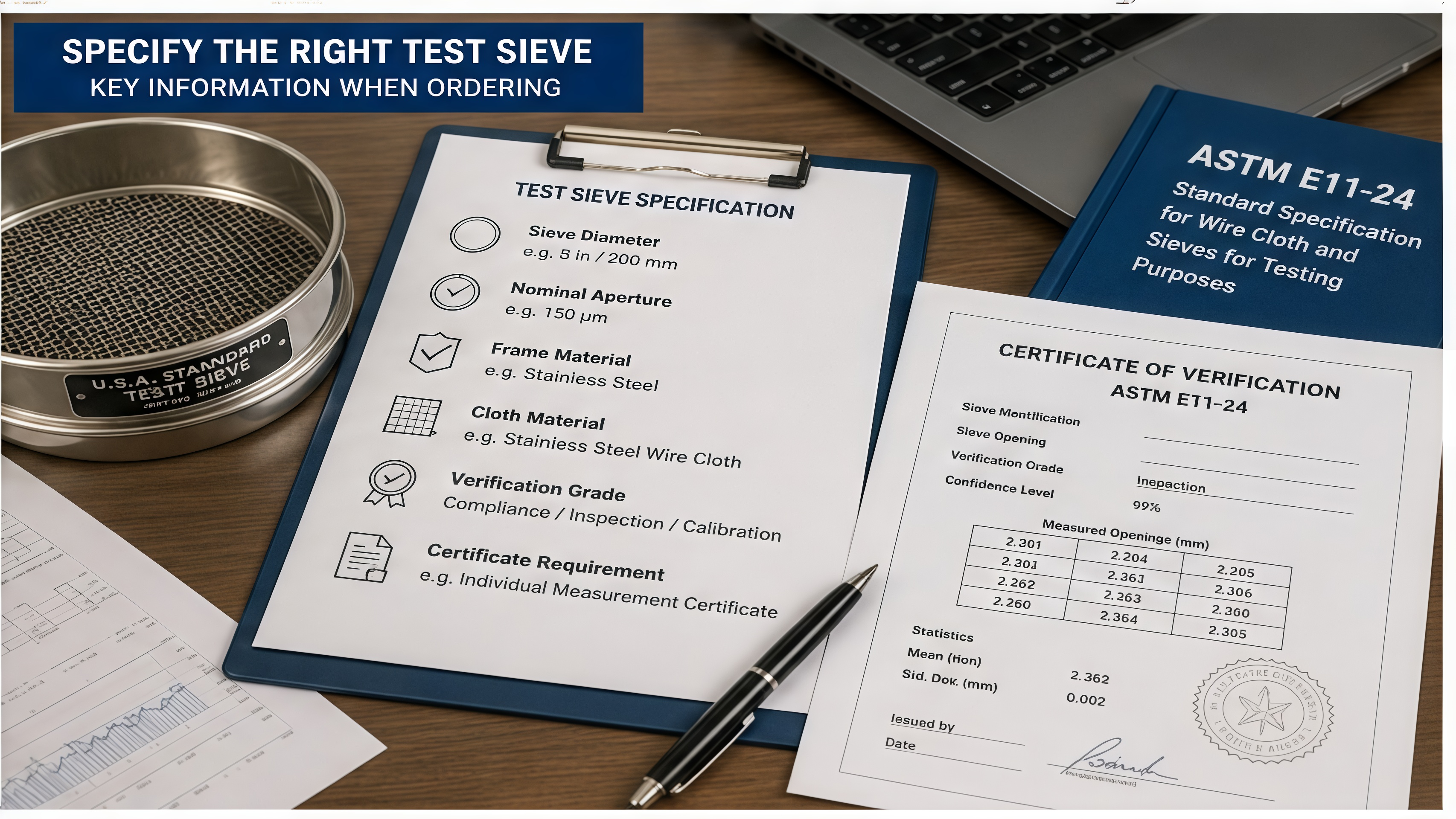
When requesting an ASTM E11 test sieve quotation, provide:
Sieve diameter + nominal aperture + frame and cloth material + ASTM E11 edition + verification grade + certificate requirementFor example:
8 in + 150 μm + stainless steel + ASTM E11-24 + Inspection + individual measurement certificateProviding these details helps the supplier match the sieve configuration and verification level with the intended application.
For ASTM E11 test sieve configurations and available verification options, see the ASTM E11 Standard Test Sieve product page.
Frequently Asked Questions
Is Calibration Grade the Most Accurate Test Sieve?
Calibration has the highest statistical confidence level among the three ASTM E11-24 verification grades. It does not mean that every application requires Calibration Grade.
Does Every ASTM E11 Test Sieve Need Calibration?
No. The required verification level depends on the applicable test method, customer specification, laboratory quality system, and documentation requirements.
-
Can You Use Standard Test Sieves for Wet Screening? Best Practices
Yes, standard test sieves can be used for wet screening in suitable applications, but the setup depends on the material ...
-
How to Choose the Right ASTM E11 Test Sieve Size and Mesh?
Choosing the right test sieve is not simply a matter of selecting a mesh number ...
-
How to Clean and Maintain Stainless Steel Laboratory Test Sieves?
Stainless steel laboratory test sieves are precision tools used for particle size analysis ...

Email:
sale@xxdahan.com
WhatsApp:
+86 15236742901
Add:
1000m West of Forest Park,Yanjin County,Xinxiang City,Henan Province,China.