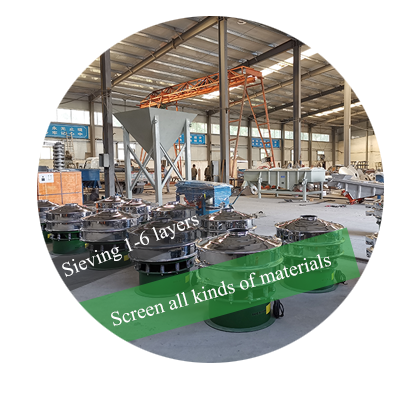
Multi-Layer Screening: 9 Factors for Choosing Decks or Layers to Maximize Efficiency
Selecting the right number of screen decks is critical. Choosing Decks or Layers to Maximize Efficiency means looking beyond deck count alone: it is about matching the configuration to your required cuts, material characteristics, throughput, and space limits. Get it right—efficient, compact operation. Get it wrong—unnecessary cost, extra maintenance, or a machine that can't make all your cuts.
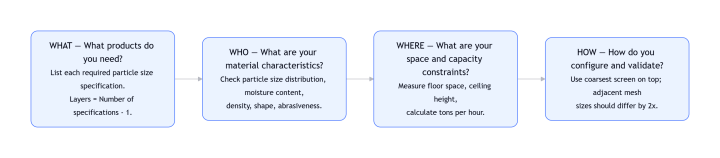
The 3W1H Decision Framework
Use this framework to guide your thinking before diving into the detailed factors.
|
Step |
Question |
Action |
|
WHAT |
What finished products do you need? |
List every size fraction required. Decks needed = fractions − 1. |
|
WHO |
What are your material characteristics? |
Check PSD, moisture, density, shape, abrasiveness. |
|
WHERE |
What are your space and throughput constraints? |
Measure floor space, ceiling height, and calculate TPH. |
|
HOW |
How will you configure and validate? |
Coarsest mesh on top; adjacent cuts need 2x separation; test before buying. |
6 Key Factors for Choosing the Right Number of Decks
What are your product and material requirements?
Direct answer: Decks needed = product fractions wanted, minus one. But your feed's near-size particle percentage determines if that configuration will actually work.
Product fractions and deck count:
|
Decks |
Fractions |
Best For |
|
1 |
2 |
Safety screening, single cut |
|
2 |
3 |
Coarse/medium/fine classification |
|
3 |
4 |
Aggregates, multiple grades |
|
4+ |
5+ |
Multiple precise gradations |
The near-size particle factor: When feed contains over 60% near-size particles (±10% of cut point), screening efficiency is often noticeably affected regardless of deck count. Consider reducing decks or increasing screen length.
What data taught us: Near-size particle percentage is an important predictor of screening efficiency—often more relevant than moisture, throughput, or deck count.
A costly mistake: A food processor ordered a triple-deck based on external advice—only needed two. This led to higher upfront investment and production scheduling impact.
What are your material's physical and chemical properties?
Direct answer: Moisture determines if you need anti-blinding and how many decks you can run. Corrosiveness/abrasiveness determines construction material.
Moisture impact:
Surface moisture above 5%: screen openings may need to be larger, or the configuration adjusted, to maintain stable throughput.
Above 8% moisture: anti-blinding systems (ultrasonic or bounce balls) are typically recommended to maintain screening performance.
Sticky materials: use fewer decks—each additional deck creates more surface area for sticking.
Case that changed our approach: A fertilizer producer's triple-deck blinded frequently due to high moisture—requiring frequent shutdowns for cleaning. After on-site observation and flow review, we replaced it with a double-deck plus ultrasonic deblinding. Uptime and maintenance intervals improved.
Factor 3: What are your throughput, space, and budget constraints?
Direct answer: If throughput exceeds one machine's capacity, two parallel double-decks often perform better than one four-deck. If floor space is limited, multi-layer is usually a more space-saving choice. Always evaluate 5-year TCO.
Throughput rules:
Operating above rated capacity often affects screening efficiency; it is generally better to operate with some margin below rated capacity.
Real lesson: A mining client wanted a single four-deck for high throughput, but evaluation indicated efficiency could suffer. Two parallel double-decks provided more stable performance and reduced rework and adjustment costs.
Space: One multi-layer machine can replace multiple single-decks. But check ceiling height—a chemical plant once faced extra modification and schedule adjustment after ordering a triple-deck that did not match site height conditions.
Factor 4: Are your adjacent cuts compatible?
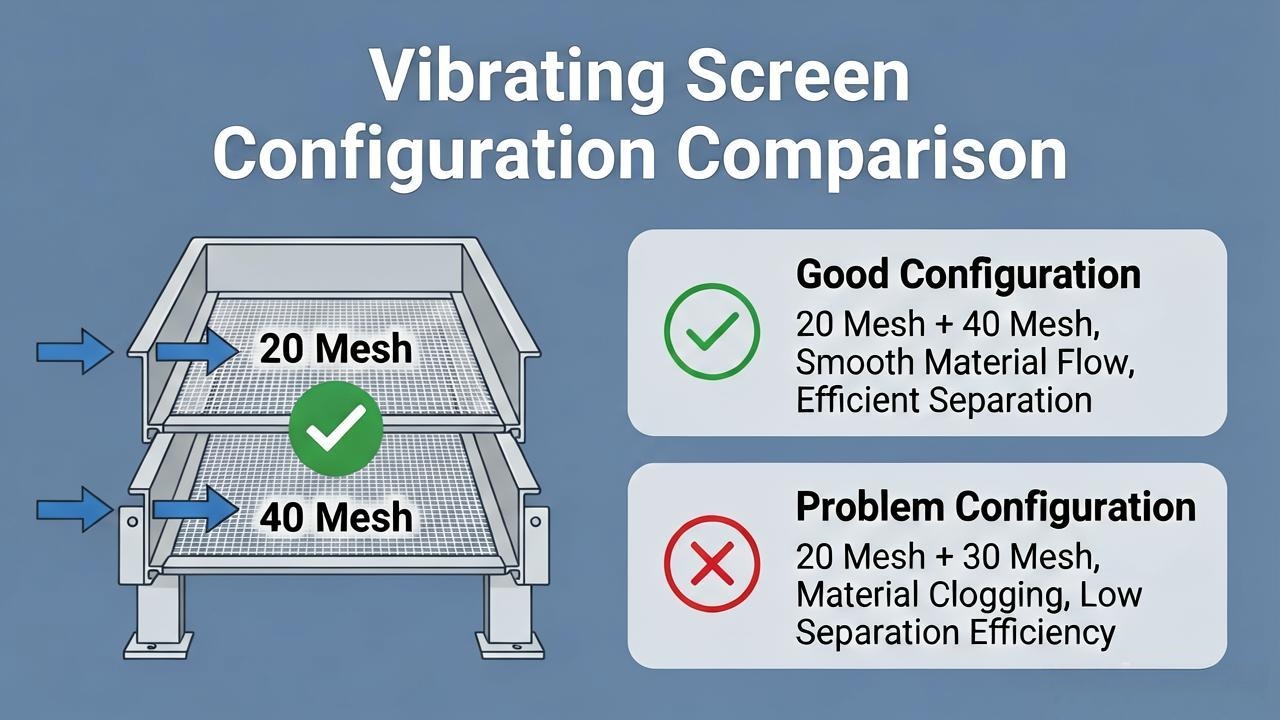
Direct answer: Adjacent mesh cuts must be separated by at least 2x in mesh size.
|
Configuration |
Result |
|
20 mesh + 40 mesh |
Works well |
|
20 mesh + 30 mesh |
Efficiency often drops noticeably |
Solutions: Widen the gap, increase upper deck length, or use two single-decks in series.
A persistent problem: A chemical company specified 50/60 mesh on a double-deck and got poor screening performance. Changing 50 mesh to 40 mesh improved results noticeably.
Factor 5: How will maintenance and accessibility affect your operation?
Direct answer: More decks = more maintenance. Each additional deck generally adds time per screen change. Lower decks take longer to access.
Quantified:
Lower-deck screen changes on triple-deck generally take longer than single-deck.
If changes are frequent, cumulative labor and maintenance costs rise.
A four-deck machine generally requires higher maintenance labor.
What we observe on-site: Lower decks on 4-deck machines are often neglected—operators find them difficult to reach, inspections get postponed, and screening performance can suffer.
Factor 6: What is your total cost of ownership?
Direct answer: Multi-layer costs more upfront, but 5-year TCO can be more favorable when multiple fractions are required.
|
Cost Component |
Impact of More Decks |
|
Initial purchase |
Increases with more decks |
|
Energy |
Increases with more decks |
|
Screen media |
More panels; higher consumable cost |
|
Maintenance labor |
More time per deck per change |
|
Floor space |
Saves space vs. multiple single-decks |
A personal mistake worth sharing: Early in my career, I recommended a single-deck to reduce upfront investment. Later, the client needed more fractions and added another machine, making total investment higher than if a double-deck had been selected initially. I now evaluate 5-year TCO on every recommendation.
Common Mistakes to Avoid
Over-specifying — A client chose a four-deck but uses only three, increasing upfront investment.
Under-specifying — An aggregates producer initially under-configured and later added equipment, resulting in higher total investment.
Ignoring material characteristics — A fertilizer plant installed a triple-deck for dry material but ran high-moisture product. Screens blinded quickly.
Putting cuts too close — A 50/60 mesh setup gave poor screening performance; a 40/60 mesh setup improved results noticeably.
FAQ
Q: Can I add a deck later if I need more fractions?
A: Some machines have upgrade capability (additional deck mounting points). Specify this upfront if expansion is likely. Retrofitting is often more expensive than selecting correctly initially.
Q: What's the maximum number of decks?
A: Most round vibratory screeners max out at 4-5 decks. Beyond that, retention time may become insufficient for proper separation on each deck.
Q: My material is sticky—should I use fewer decks?
A: Yes. Each additional deck creates more surface area for material to stick to. Start with fewer decks and consider anti-blinding technology first.
Q: How do I know if I'm over-specifying?
A: If you're unsure whether you need all the fractions listed, you may be over-specifying. Map your entire production workflow first. In our audits, some machines have at least one underused deck.
Q: How does deck count affect energy consumption?
A: Each additional deck typically increases energy consumption due to heavier screen box and additional vibration mass.
How to Calculate Vibro Sifter Capacity and Yield? Formula & Selection Guide
Calculating How to Calculate Vibro Sifter Capacity and Yield? requires more than checking screen diameter or machine specifications...
Preventing Mesh Clogging in High-Moisture Grain Screening: Practical Solutions
Screening grains with elevated moisture levels routinely triggers severe mesh blinding...
How to Choose Between Stainless Steel and Synthetic Mesh for Polymer Screening
In polymer extrusion and compounding, the screen mesh sits between the screw and the die...

Email:
sale@xxdahan.com
WhatsApp:
+86 15236742901
Add:
1000m West of Forest Park,Yanjin County,Xinxiang City,Henan Province,China.