AASHTO M247 vs. EN 1423: Road Marking Glass Bead Specifications
Road marking glass beads are spherical glass particles used as drop-on materials to improve the retroreflectivity of pavement markings.When comparing AASHTO M247 vs. EN 1423, nominal bead size alone is not enough. The applicable standard edition, gradation, refractive index, defective beads, surface treatment and test method should be checked before accepting a glass bead batch.
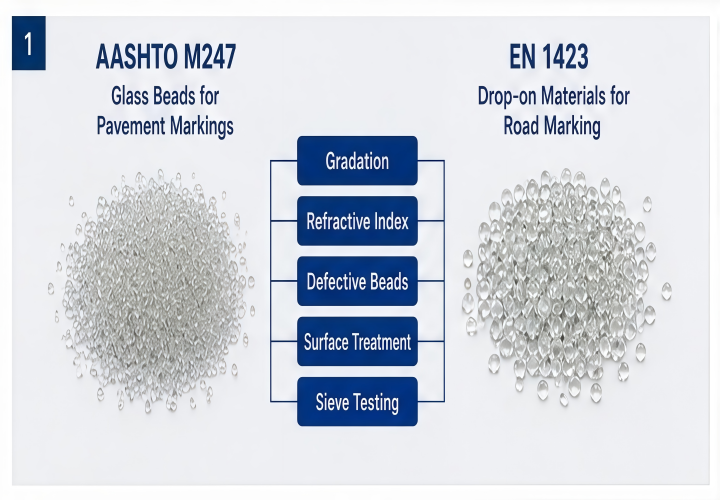
AASHTO M247 vs. EN 1423: Key Differences
EN 1423 covers glass beads, anti-skid aggregates and mixtures used as drop-on materials on road-marking products.
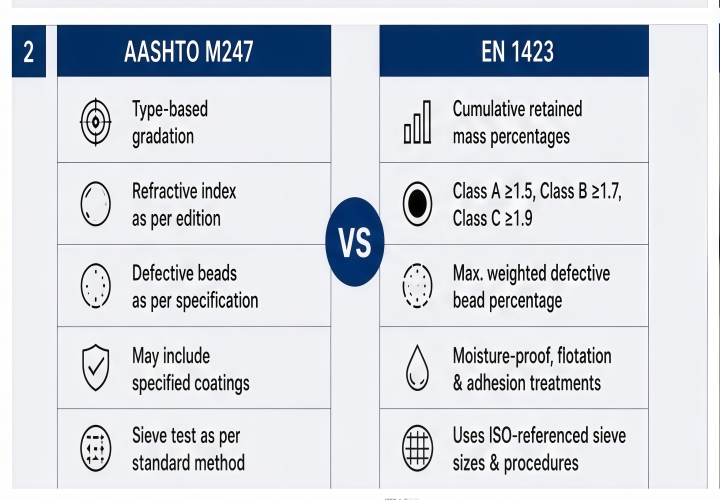
| Item | AASHTO M 247 | EN 1423 |
|---|---|---|
| Main scope | Glass beads used in pavement markings | Drop-on glass beads, anti-skid aggregates and mixtures |
| Main application | Pavement marking projects using AASHTO requirements | Road-marking projects using EN requirements |
| Gradation | Type-based requirements | Cumulative retained mass percentages |
| Refractive index | Defined by the applicable edition | Class A ≥ 1.5, Class B ≥ 1.7, Class C ≥ 1.9 |
| Defective beads | Controlled by specification requirements | Maximum weighted defective-bead percentage specified |
| Surface treatment | May include specified coatings | Moisture-proof, flotation and adhesion treatments are addressed |
| Sieve testing | Used to determine particle-size distribution | Uses ISO-referenced sieve sizes and procedures |
What Is AASHTO M247?
AASHTO M 247 specifies glass beads dropped or sprayed onto pavement markings to produce reflectorized pavement markings.The current edition is AASHTO M 247:2026, published on August 8, 2026, and it supersedes AASHTO M 247-13(2022).
The specification covers requirements for glass beads used in pavement markings, including particle-size distribution and other required material properties. Because older M 247 tables remain in circulation, the edition specified by the project should always be confirmed.
What Is EN 1423?
EN 1423:2012 specifies requirements for drop-on materials used on road markings, including glass beads, anti-skid aggregates and mixtures of the two. The standard is currently listed as valid and is amended by EN 1423:2012/AC:2013.
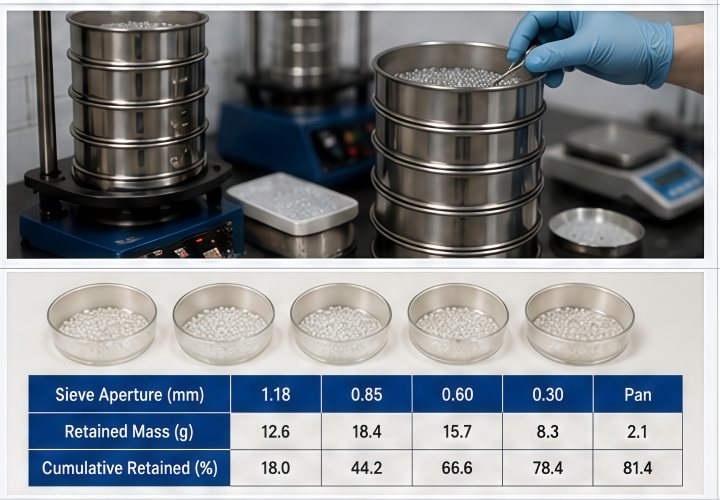
For glass beads, EN 1423 addresses:
Granulometry
Refractive index
Defective glass beads
Chemical resistance
Surface treatment
A nominal bead size alone therefore does not demonstrate conformity.
How Does Glass Bead Gradation Differ?
Gradation is one of the main differences between AASHTO M 247 and EN 1423.AASHTO M 247 uses type-based gradation requirements.
EN 1423 expresses granulometry through cumulative retained mass percentages on selected metal-wire-cloth test sieves. Its sieve selection and test-sieving approach reference ISO standards.
For EN 1423, the upper safety sieve retains 0% to 2%, the upper nominal sieve 0% to 10%, and the lower nominal sieve 95% to 100%. Where intermediate sieves are required, the ratio between successive nominal openings is limited to 1.7:1.
Therefore, a similar nominal particle-size range does not prove that two glass bead products meet the same specification.
Refractive Index Requirements
Refractive index is an important optical property of road marking glass beads.
| EN 1423 Class | Minimum Refractive Index |
|---|---|
| Class A | ≥ 1.5 |
| Class B | ≥ 1.7 |
| Class C | ≥ 1.9 |
For AASHTO M 247, the required refractive index should be checked against the applicable edition.
Refractive index should not be evaluated alone because bead size, roundness and embedment can also affect retroreflective performance.
Defective Beads and Glass Quality
EN 1423 specifies a maximum weighted percentage of 20% defective glass beads, including a maximum of 3% grains and foreign particles under its reference procedure.
AASHTO M 247 also includes glass bead quality requirements, so the applicable edition should be identified before using numerical acceptance limits.
For batch approval, laboratory test results should be used together with the applicable standard and batch information.
How Are Road Marking Glass Beads Tested by Sieve Analysis?
Sieve analysis measures the actual particle-size distribution of a glass bead sample.
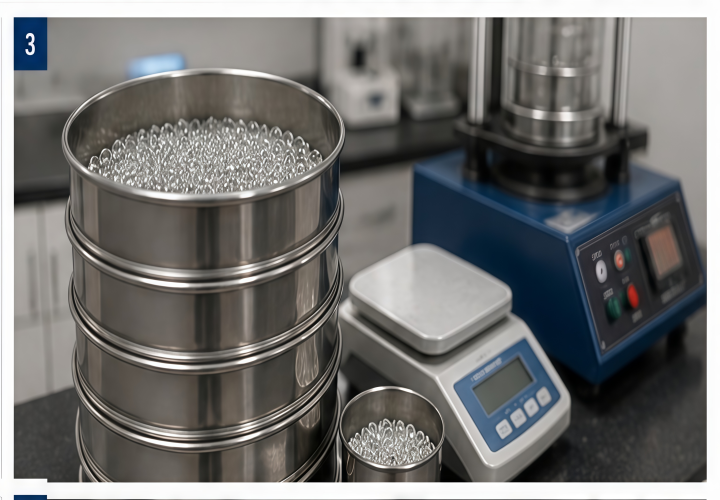
Confirm the standard and edition: Determine whether the project requires AASHTO M 247, EN 1423 or another specification.
Identify the required sieve apertures: Use the openings specified by the applicable gradation system rather than relying only on mesh numbers.
Prepare a representative sample: Handle the sample carefully to minimize contamination and material loss.
Conduct the sieve test: Arrange the selected sieves from larger to smaller aperture and follow the applicable procedure.
Record retained mass: Measure the material retained on each sieve.
Calculate and compare the results: Calculate the required retained or passing percentages and compare them with the specified acceptance limits.
What Should Be Checked Before Approving a Glass Bead Batch?
| Checkpoint | What to Verify | Why It Matters |
|---|---|---|
| Standard edition | Exact edition required | Prevents outdated criteria |
| Gradation | Sieve-by-sieve distribution | Confirms particle-size conformity |
| Refractive index | Actual value or required class | Verifies optical requirements |
| Defective beads | Test result | Evaluates bead quality |
| Surface treatment | Type and function | Confirms application requirements |
| Test method | Applicable procedure | Makes results comparable |
| Batch identification | Lot or production reference | Supports traceability |
Common Mistakes When Comparing AASHTO M247 and EN 1423
Comparing Only Nominal Bead Size
A size such as 600–850 μm does not show the complete particle-size distribution.
Using Mesh Number Instead of Aperture
Mesh designation and sieve aperture should not be treated as interchangeable. The applicable test method should determine the required sieve opening.
Using an Old AASHTO Table
AASHTO M 247:2026 supersedes M 247-13(2022), so historical tables should not be treated as current requirements without checking the specified edition.
Are AASHTO M247 and EN 1423 Glass Beads Interchangeable?
Not automatically.
Similar bead size or refractive index does not prove compliance with both standards. The complete edition, gradation, sieve results, optical properties and quality requirements should be checked.
How to Choose Test Sieves for Road Marking Glass Bead Testing?
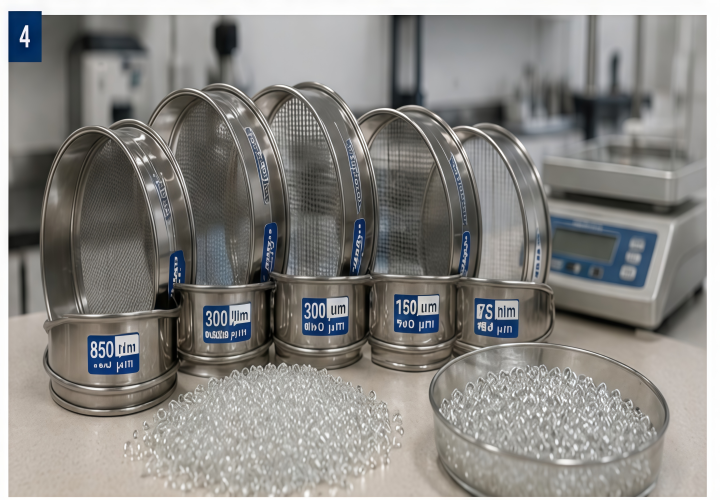
Select the test sieve according to the required aperture, sieve standard and test method.Before ordering, confirm the required aperture, sieve diameter, frame and mesh material, number of sieves and verification or calibration requirements.Dahan can provide test sieve configurations based on the required apertures and laboratory testing application.
Frequently Asked Questions
What is the main difference between AASHTO M247 and EN 1423?
AASHTO M 247 specifies glass beads used in pavement markings, while EN 1423 covers drop-on materials including glass beads, anti-skid aggregates and mixtures. Their gradation and conformity systems are different.
What refractive index classes are defined by EN 1423?
EN 1423 defines Class A at n ≥ 1.5, Class B at n ≥ 1.7 and Class C at n ≥ 1.9.
How is glass bead granulometry determined under EN 1423?
EN 1423 uses selected test sieves and expresses granulometry through cumulative retained mass percentages.
Can the same glass bead size meet both standards?
Not necessarily. The complete gradation, refractive index, defective-bead requirements and applicable test criteria must be checked separately.
What is the current AASHTO M247 edition?
The current edition is AASHTO M 247:2026, which supersedes AASHTO M 247-13(2022).
Conclusion
AASHTO M247 vs. EN 1423 is not simply a comparison of glass bead size. Standard edition, gradation, sieve results, refractive index and quality requirements should be considered together.For laboratory testing, selecting the correct sieve apertures and following the applicable test method are essential for reliable particle-size results.
-
Can You Use Standard Test Sieves for Wet Screening? Best Practices
Yes, standard test sieves can be used for wet screening in suitable applications, but the setup depends on the material ...
-
How to Choose the Right ASTM E11 Test Sieve Size and Mesh?
Choosing the right test sieve is not simply a matter of selecting a mesh number ...
-
How to Clean and Maintain Stainless Steel Laboratory Test Sieves?
Stainless steel laboratory test sieves are precision tools used for particle size analysis ...

Email:
sale@xxdahan.com
WhatsApp:
+86 15236742901
Add:
1000m West of Forest Park,Yanjin County,Xinxiang City,Henan Province,China.