Vibrating Sieve for Powder & Slurry
![[field:title/]](/uploads/261019/6-2610191P311551.jpg)
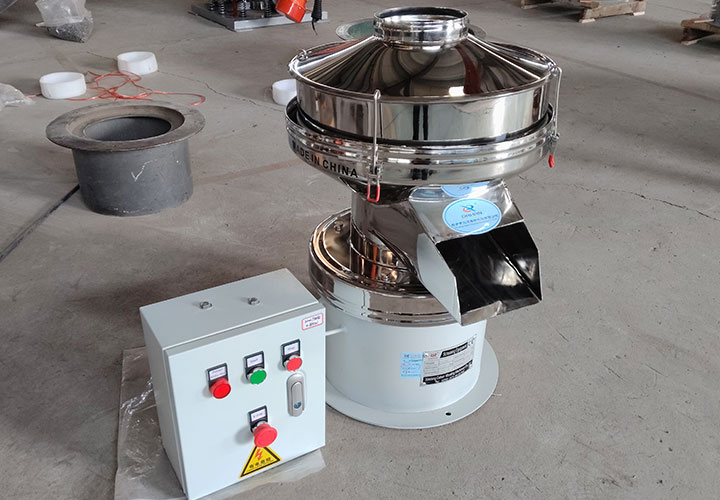
Callback
| Dry Powder Capacity: | 100–3,300 kg/h* |
| Mesh Range: | 2–500 Mesh* |
| Slurry Capacity: | 1–5 t/h* |
| Fine Filtration: | Down to 5 μm* |
Grades dry powders and filters liquid slurries.
Separates oversized particles and unwanted solids.
Optional anti-blinding systems support continuous screening.
Screen configuration tailored to material and filtration needs.
What is a Vibrating Sieve for Powder & Slurry?
In industrial powder processing and liquid filtration operations, fine powders frequently clump due to electrostatic adsorption, causing top-layer accumulation and bottom-mesh clogging. Similarly, high-viscosity impurities in slurry filtration rapidly block standard screens, forcing costly production line downtime. The Vibrating Sieve for Powder & Slurry effectively overcomes these operational bottlenecks. Designed to handle ultrafine powders down to 5 microns (500 mesh) and achieve an hourly solid-liquid separation output of 1 to 5 tons, this high-performance industrial sifter ensures continuous, high-efficiency material grading and impurity removal.
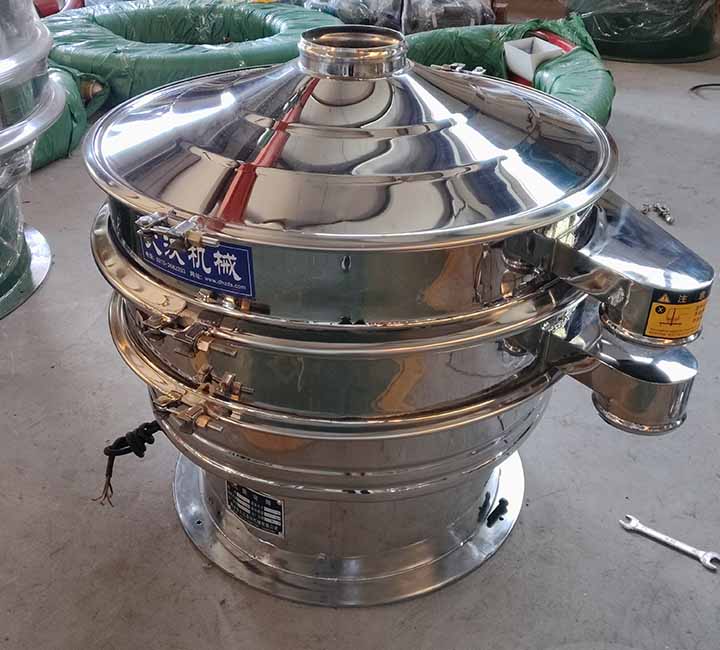
Application Scenarios of Vibrating Sieve for Powder & Slurry
Our industrial vibrating screens play a pivotal role in fine material control across diverse sectors. Below are the primary application scenarios for both dry powders and liquid slurries:
Dry Powder Processing Applications
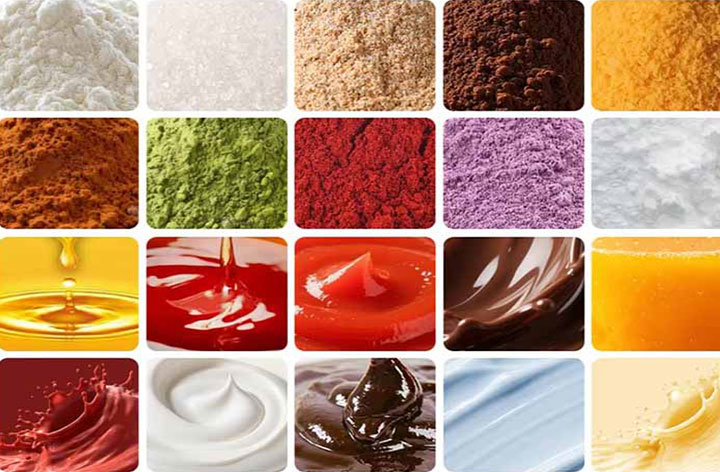
3D Printing Metal Powder Coarse Screening: In the recycling of aerospace-grade titanium and aluminum powders, the sieve rapidly intercepts out-of-gauge particles and sintered lumps to protect subsequent printing equipment.
Lithium Battery Cathode Material Grading: Accurately classifies ternary materials and lithium iron phosphate (LFP) powders to ensure strict particle size uniformity.
Flour and Starch Impurity Removal: Breaks up transportation lumps and removes fiber debris from packaging bags prior to food processing.
Liquid and Slurry Filtration Applications
Ceramic Slurry Filtration: Filters fine iron filings and undissolved lumps before glaze enters the spray drying tower, eliminating surface black spots on finished porcelain.
Paper Coating Solid-Liquid Separation: Continuously intercepts solidified skins and coarse fibers in paper coatings to guarantee a smooth, flawless finish.
Juice and Beverage Residue Removal: Separates residual seeds and plant fibers post-pressing to maximize liquid clarity before bottling.
Key Benefits and Core Technologies of Vibrating Sieve for Powder & Slurry
Through advanced structural optimization, our vibrating screen for powders and slurries effectively resolves high-intensity wear and dust leakage issues during continuous operation.
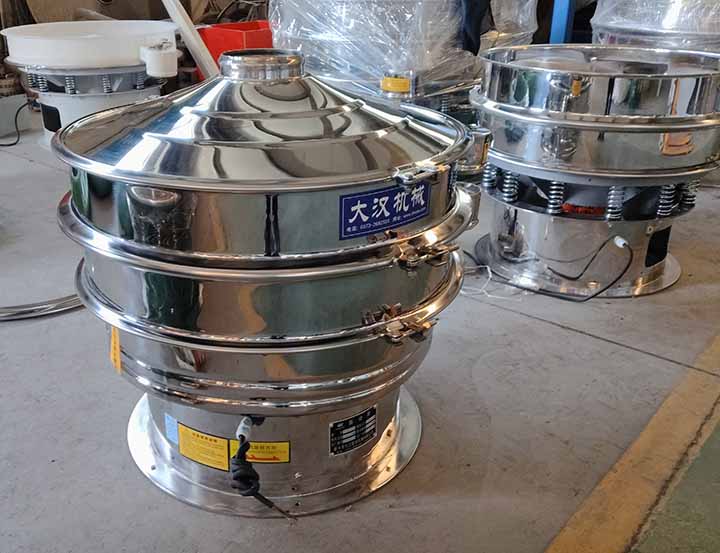
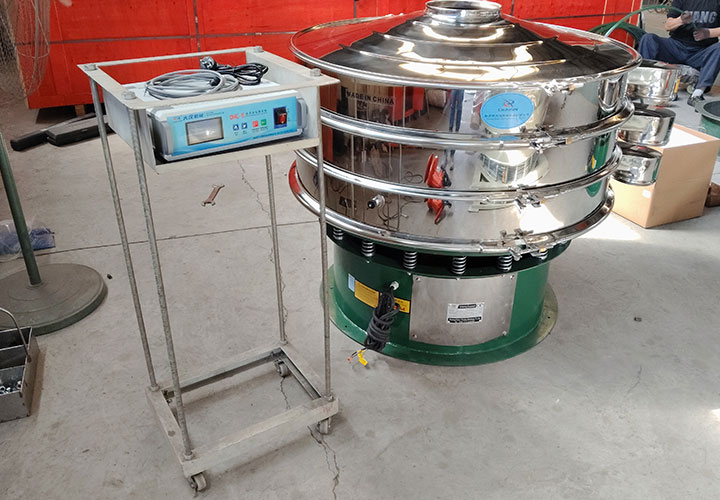
Advanced Anti-Clogging Technology: For fine powders below 45$\mu$m, the equipment features a bouncing ball screen-cleaning device that uses food-grade silicone balls to disrupt material surface tension via up-and-down impacts on the support plate. For highly viscous or statically charged powders, an optional 28kHz ultrasonic generator transmits high-frequency vibrations directly to the mesh wires, keeping materials suspended and maintaining a mesh opening rate exceeding 95%.
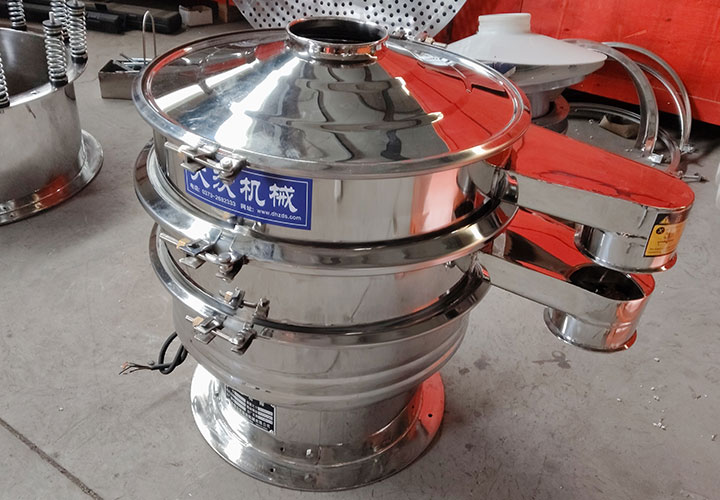
Quick-Opening Clamp Design: The screen body utilizes a quick-release V-shaped clamping ring. Maintenance personnel can manually loosen the locking handle without heavy wrenches, allowing a single screen layer to be disassembled and replaced within 3 to 5 minutes to minimize downtime during material changeovers.
Hermetically Sealed Structure: All frame joints are inlaid with FDA-compliant silicone sealing strips combined with a grooved clamping mechanism. This ensures zero dust emissions or liquid leaks when the machine withstands a 5kPa positive pressure, safeguarding a clean, eco-friendly workshop environment.
How Does a Vibrating Sieve for Powder & Slurry Operate?
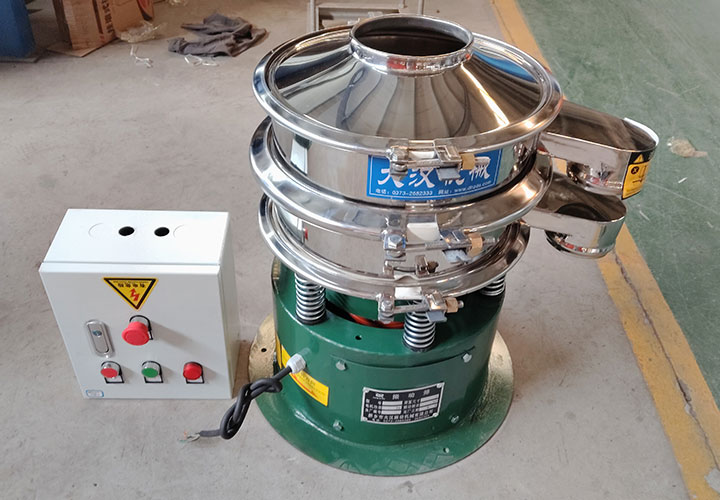
The equipment operates using an advanced vertical vibrating motor. The unbalanced eccentric weights at both ends convert rotational power into three-dimensional vibrations (incorporating horizontal, vertical, and inclined motions) and transmit this energy directly to the screen surface. This forces materials to feed from the top center and spiral outward to the periphery. The material trajectory can be flexibly adjusted by modifying the phase angle of the upper and lower weights: a larger angle extends residence time for finer, high-precision screening, while a smaller angle accelerates material flow to the discharge port, making it ideal for high-volume coarse screening or slurry dewatering.
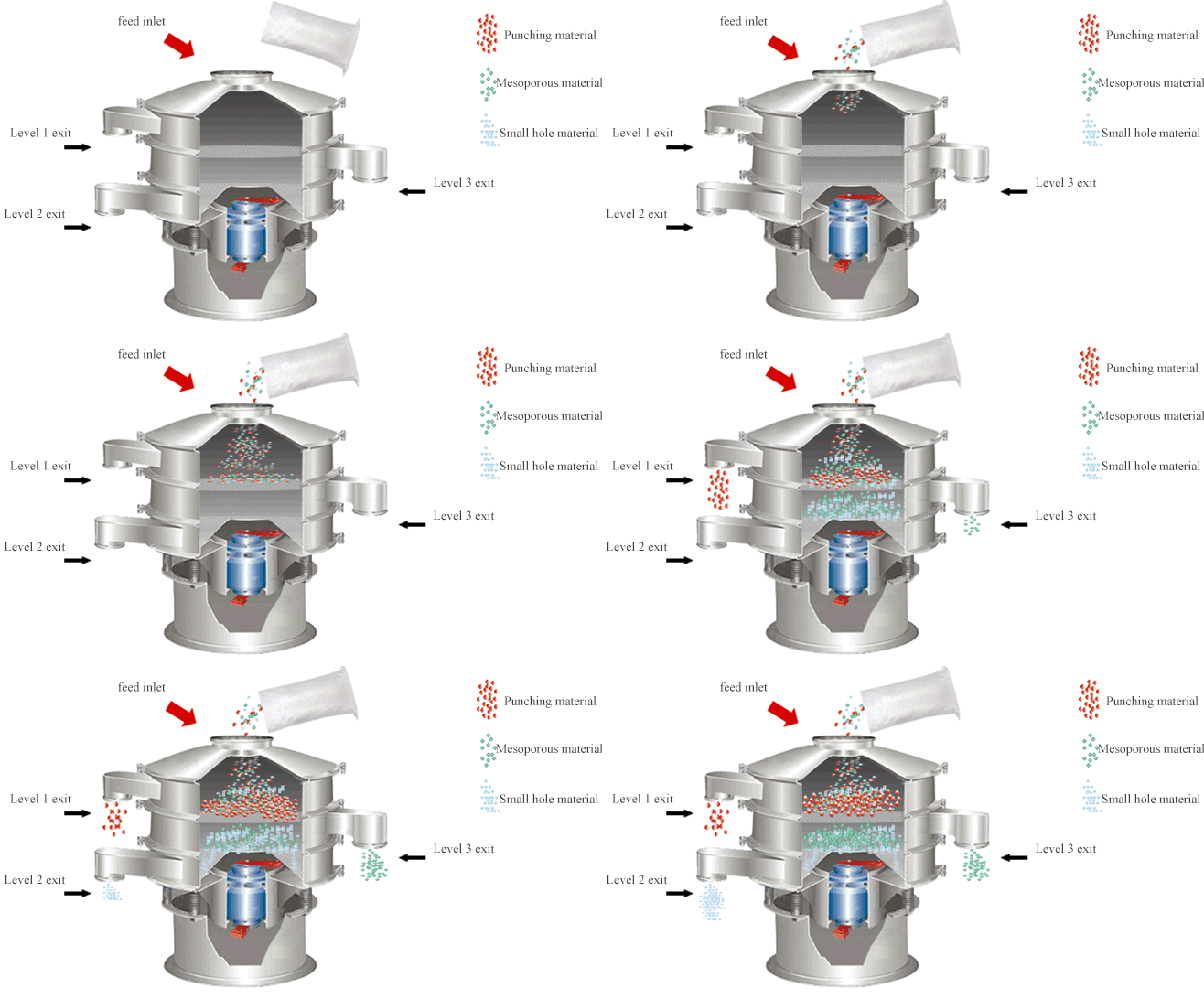
Technical Specifications of Vibrating Sieve for Powder & Slurry
Refer to the standard technical parameters below to select the optimal model matching your production capacity and site requirements:
| Model | Diameter (mm) | Feeding Size (mm) | Frequency (RPM) | Layers | Power (kw) | Capacity (kg/h) |
|---|---|---|---|---|---|---|
| DH-400 | 400 | <10 | <1500 | 1-5 | 0.18 | 100 |
| DH-600 | 600 | 0.25 | 200 | |||
| DH-800 | 800 | 0.55 | 500 | |||
| DH-1000 | 1000 | 0.75 | 800 | |||
| DH-1200 | 1200 | 1.1 | 1200 | |||
| DH-1500 | 1500 | 1.5 | 1800 | |||
| DH-1800 | 1800 | 2.2 | 2000 |
Customer Success Story: Solving Oily Feed Screening Bottlenecks
Screening oily or high-viscosity materials has long been an industry challenge because fine particles quickly cause severe mesh blinding and sharp drops in productivity. A prominent aquafeed manufacturer with over ten years of industry experience faced precisely this issue: most of their aquatic formula feed raw materials contained high oiliness, causing heavy screen blockage within a short period.
To resolve this, our engineering team recommended the Ultrasonic Sieving Machine configuration designed specifically for sticky and viscous materials. By applying high-frequency ultrasonic energy directly to the mesh, the system successfully eliminated surface tension and prevented oil-induced particle adhesion.
How Much Does a Vibrating Sieve for Powder & Slurry Cost?
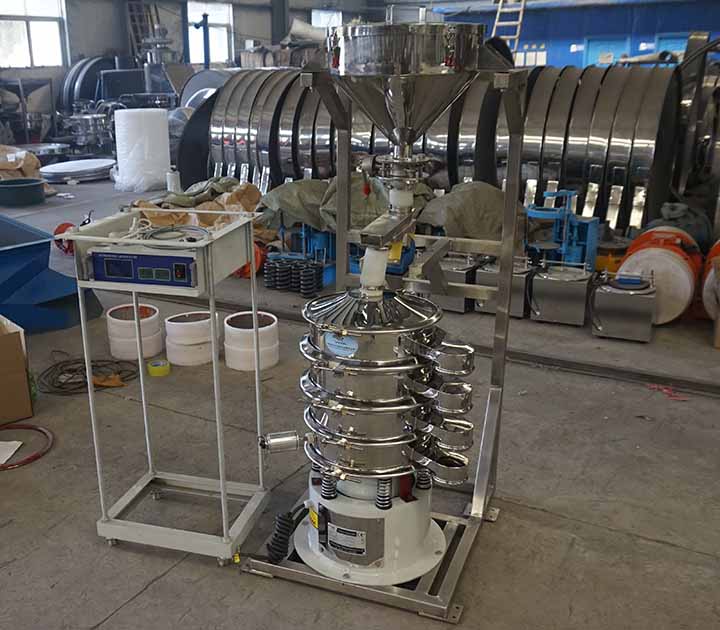
The price of a single Vibrating Sieve for Powder & Slurry typically ranges from $1,500 to $12,000. The decisive factors influencing the overall cost include the following specifications:
Diameter and Number of Layers: The steel consumption and motor power requirements of a compact, single-layer machine (e.g., 600mm diameter) differ substantially from a heavy-duty, multi-layer machine (e.g., 1500mm diameter with 3 layers), resulting in varying investment levels.
Material Selection: The construction materials used for parts in direct contact with the material—such as standard SUS304 stainless steel, corrosion-resistant SUS316L stainless steel, or specialized Teflon-lined coatings for high acid/alkali resistance—directly affect raw material and fabrication costs.
Optional Custom Systems: The inclusion of advanced add-ons, such as a 28kHz ultrasonic anti-clogging generator and transducer assembly. Systems equipped with ultrasonic technology involve additional specialized components compared to standard models that rely solely on bouncing balls.
Frequently Asked Questions About Vibrating Sieve for Powder & Slurry
Which type of sieve is best used for screening fine powder?
For fine powders ranging between 100 and 500 mesh, an ultrasonic vibrating sieve is typically recommended. Standard sieves often fail due to static electricity and friction causing powder to adhere to mesh openings, whereas high-frequency, low-amplitude ultrasonic vibrations effectively break this physical adsorption.
How do I choose between a standard and an ultrasonic vibrating sieve for my powder?
The choice depends on your powder's physical properties and mesh size. If your particle size is larger than 120 mesh (greater than 125 microns), dry, non-sticky, and free of static, a standard model with bouncing balls is sufficient. If your powder is smaller than 200 mesh, highly adsorptive, prone to agglomeration, or contains moisture/static, an ultrasonic model is essential to prevent rapid mesh clogging.
What is the maintenance cycle for the screen mesh when filtering high-viscosity slurry?
For continuous 8-hour daily operations involving high-viscosity slurry, the screen mesh should be cleaned at the end of each shift to prevent residue from drying and solidifying. The overall mesh replacement cycle typically ranges from 2 to 6 months, depending on the hardness and abrasiveness of the solid particles.
Choosing the Right Solution for Your Production Line
The Vibrating Sieve for Powder & Slurry successfully achieves 5-micron fine powder grading in dry processing and impressive slurry filtration rates of several tons per hour in wet operations. Selecting the right diameter, construction material, and anti-clogging accessories based on your specific material characteristics, throughput demands, and budget is vital to ensuring seamless, uninterrupted production.
Ready to Optimize Your Screening and Filtration Line?
Contact our engineering team today for a free custom sizing recommendation, technical drawing, or direct factory pricing quotation.
-
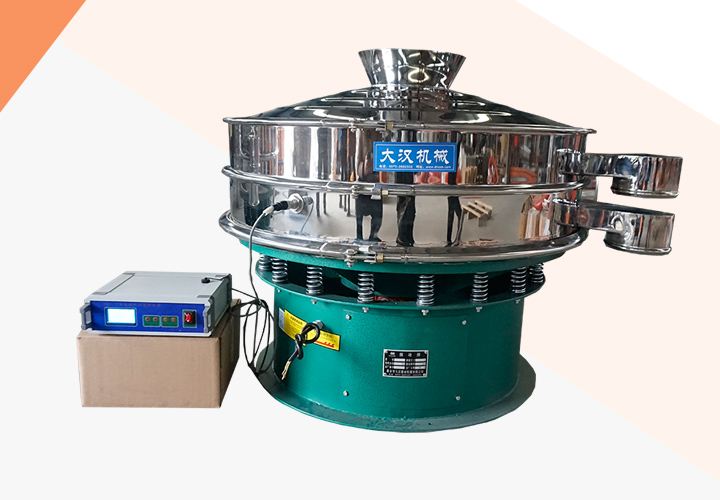
High -frequency vibration sieve for latex paint filter
High -frequency vibration sieve for latex paint filter is a filtration device designed for high-viscosity liquid systems such as water-based paints ...
-
Stainless Steel vs Carbon Steel Vibrating Screen
Stainless Steel vs Carbon Steel Vibrating Screen have the same structure and screening principle...
-
How to Choose the Right Sieving Mesh Size
When using a screening machine to screen materials, users often wonder what mesh size to choose...

Email:
sale@xxdahan.com
WhatsApp:
+86 15236742901
Add:
1000m West of Forest Park,Yanjin County,Xinxiang City,Henan Province,China.