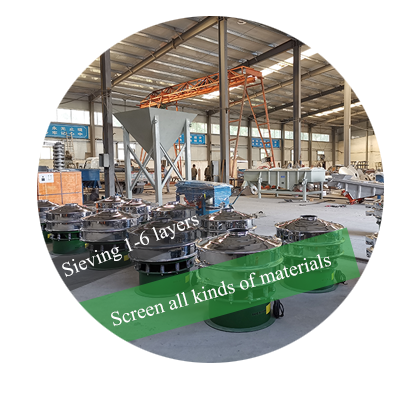
Hemp core powder vibrating screen
![[field:title/]](/uploads/260914/6-260914160232344.jpg)
Callback
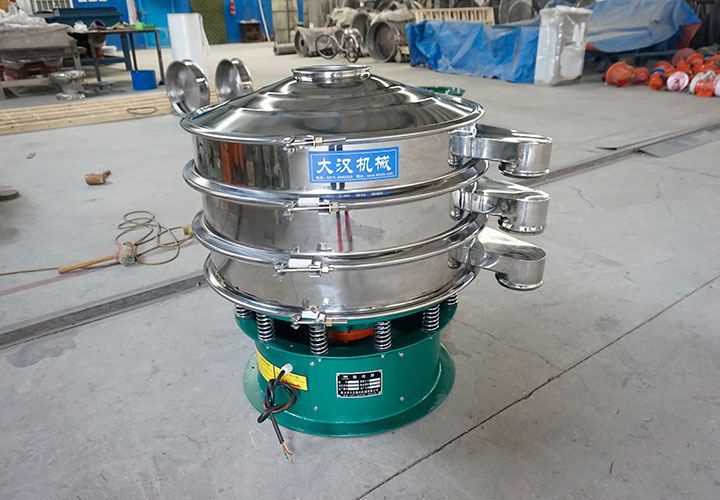
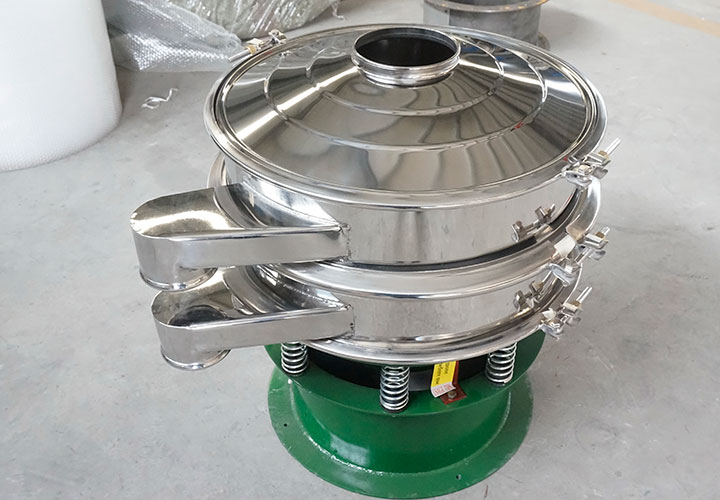
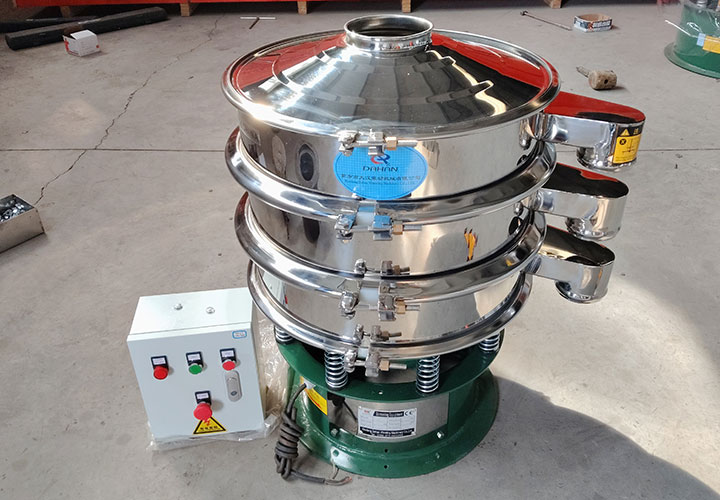
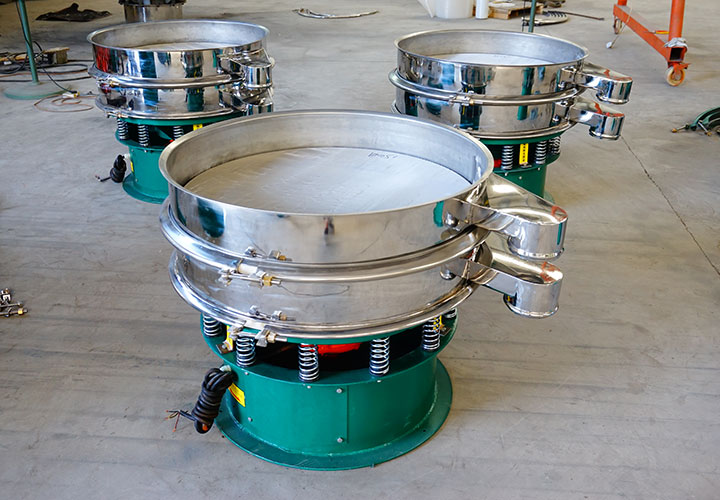
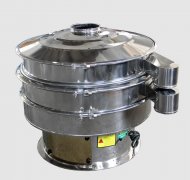
Hemp core powder vibrating screen is a device used to screen and separate fine particles such as hemp core powder. It moves the material on the screen surface by vibration to achieve the purpose of classification.
Screen specifications: 10-800 mesh
Output: 100-2000kg/h
Power: 0.25-3kw
What Is Hemp Core Powder and Why Does It Need Special Screening?
Hemp core powder (also known as hemp hurd powder or hemp shive powder) refers to the powdered material extracted from the woody inner core of hemp plant stems. The hemp stem consists of two main parts: the outer bast fiber (used for textiles and rope) and the inner core pith — a soft, porous, lightweight tissue rich in cellulose and lignin. After the bast fiber is extracted for textile applications, the remaining woody core is processed through crushing, drying, and milling to produce hemp core powder.
Why is specialized screening equipment needed? Hemp core powder has unique characteristics that make screening challenging:
Lightweight and fibrous — particles tend to float and adhere to screen surfaces
Electrostatic properties — fine powder tends to generate static charge causing screen blinding
Wide particle size distribution — from coarse fibers to ultra-fine powder
Moisture sensitivity — hygroscopic nature can cause agglomeration
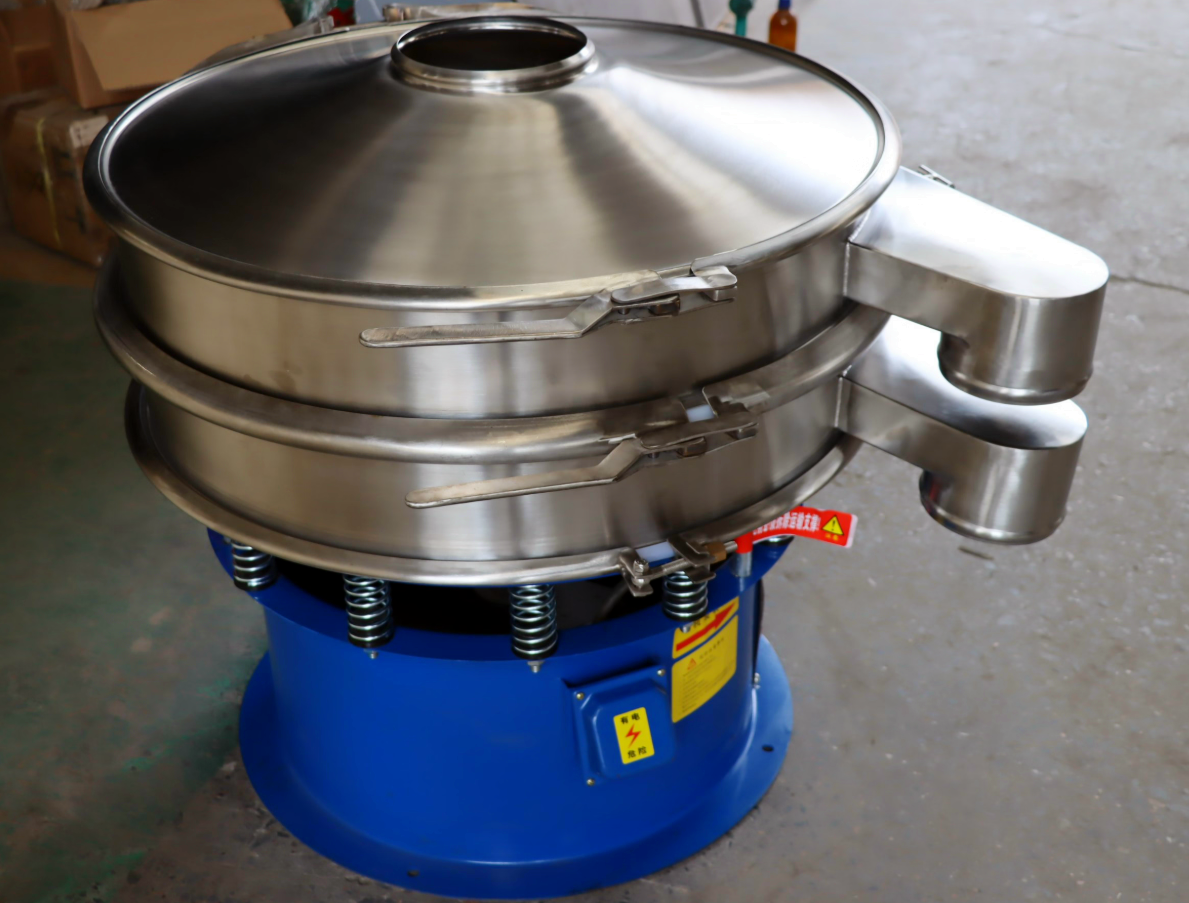
The hemp core powder vibrating screen is an industrial equipment specifically engineered to address these challenges. Its core working principle uses the exciting force generated by a vibration motor to make hemp core powder jump and move across multiple layers of sieves with different mesh sizes, achieving precise classification of powders by particle size.
Common configurations include a 20-mesh coarse screen to remove large impurities, 40-mesh and 80-mesh medium screens to separate powders of different coarseness, and 100+ mesh fine screens to obtain ultra-fine hemp core powder for high-value applications.
Core Functions of Hemp Core Powder Vibrating Screen
The hemp core powder vibrating screen is a mechanical equipment that uses vibration principles to separate and screen hemp core powder. Its main functions are:

Particle Size Classification & Grading
The primary function is to separate hemp core powder into different particle size fractions. By configuring multiple screen decks with different mesh sizes (typically 20-500 mesh), the equipment can produce 2-4 graded products simultaneously — from coarse particles (>20 mesh) to ultra-fine powder (<200 mesh) — meeting diverse application requirements.
Impurity Removal & Purification
The vibrating screen effectively removes contaminants from hemp core powder, including: oversized particles, foreign materials (dust, dirt), fiber clumps, and other impurities introduced during harvesting, drying, or milling. This purification step is essential for industries requiring high-purity hemp core powder, such as pharmaceutical excipients, food additives, and high-end biocomposites.
Yield Optimization & Quality Control
By accurately controlling particle size distribution, the vibrating screen enables manufacturers to: maximize yield of the target particle size fraction, reduce waste of valuable fine powder, ensure consistent product quality batch after batch, and meet specific customer specifications for downstream applications.
4 Types of Vibrating Screens for Hemp Core Powder: Which One Fits Your Production Line?
Based on the unique characteristics of hemp core powder — lightweight, fibrous, and prone to static buildup — the following four vibrating screen types are most commonly used in the industry:
Rotary Vibrating Screen (Circular Vibrating Screen)
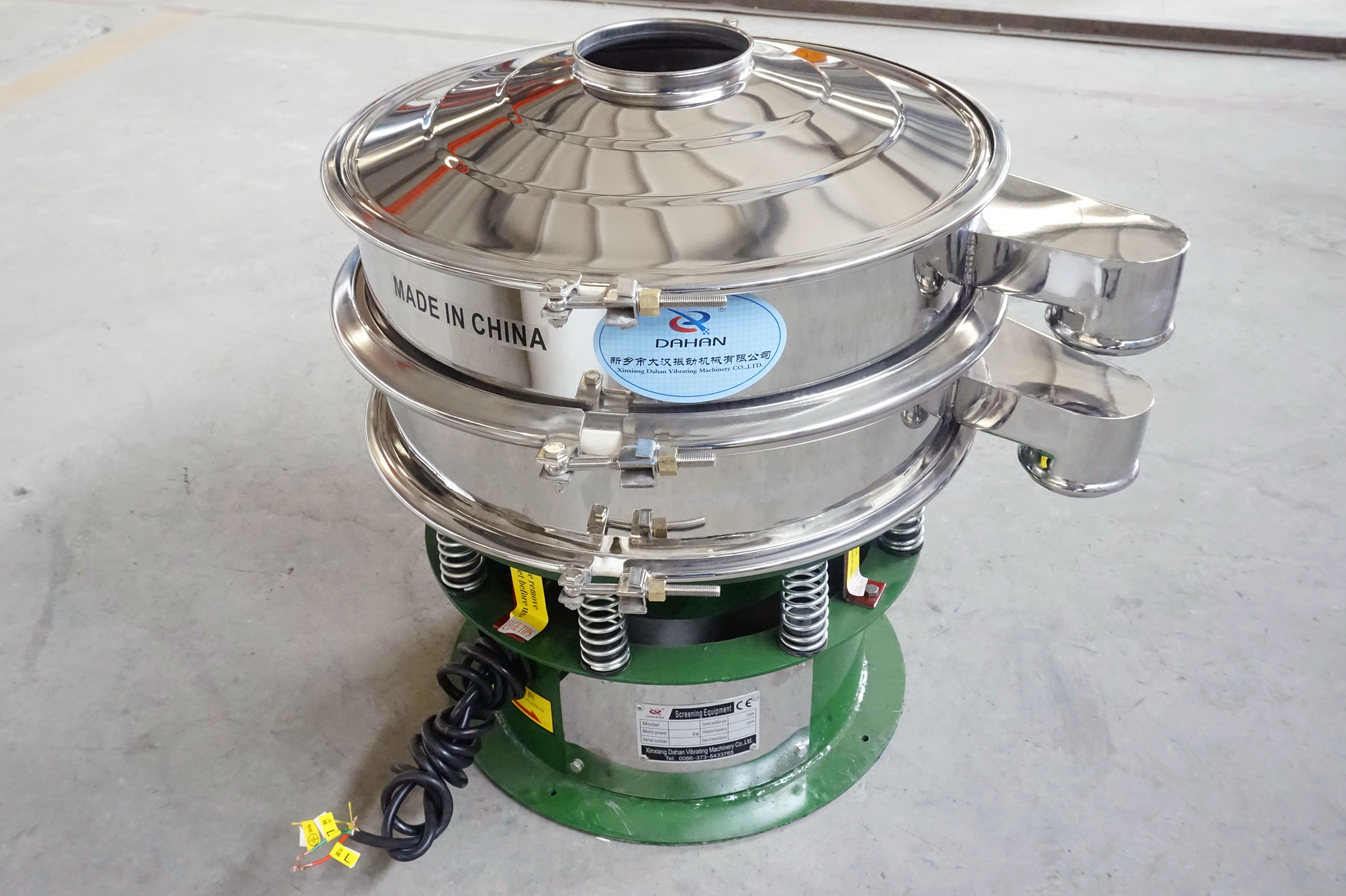
Best for: Fine particle screening (20-500 mesh) with good powder fluidity
Key features: Multi-layer configuration for 2-4 grade classification; excellent sealing to prevent dust leakage; easy to clean and quick screen replacement
Limitation: May experience screen blinding when processing hemp core powder with strong fibrous properties
Pro Tip: When screening below 100 mesh, pair with an ultrasonic vibrating system to prevent blinding.
Capacity: 100-5000 kg/h | Mesh Range: 20-500 mesh
Recommended for: Fine powder applications (paper pulp, biocomposites, food-grade hemp powder)
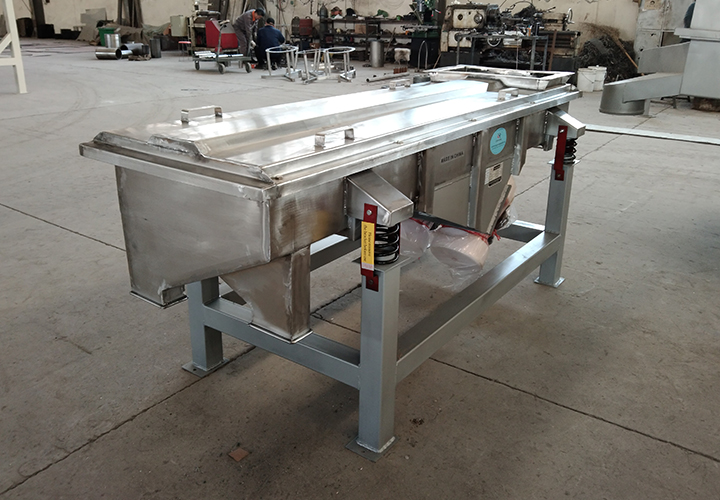
Linear Vibrating Screen
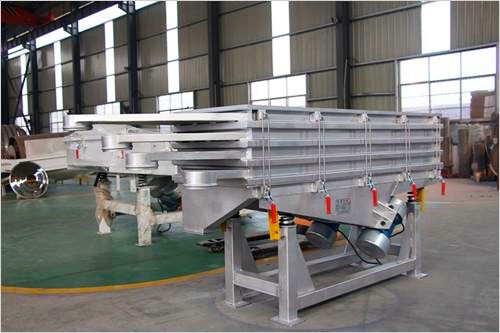
Best for: Rapid coarse screening of hemp core powder containing impurities of varying particle sizes
Key features: Suitable for medium to coarse particle screening; high throughput capacity; long screen surface enables large processing volumes
Limitation: Relatively poor sealing; requires dust collection system installation
Capacity: 500-20000 kg/h | Mesh Range: 10-200 mesh
Recommended for: Primary screening, high-volume coarse separation, pre-screening before fine milling
Airflow Screen (Air Classifying Screen)
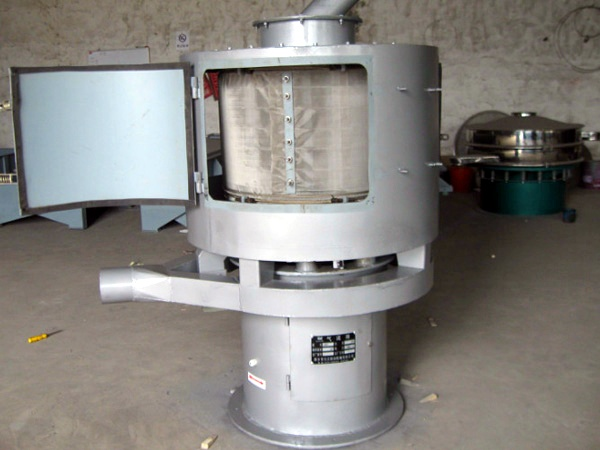
Best for: Fine powder screening where hemp core powder is prone to dusting and flying
Key features: Uses negative pressure airflow + rotating blades for screening; high-efficiency fine screening for particles <200 mesh; fully sealed with excellent dust-proof performance
Limitation: Lower throughput; complex structure; best for processes with high powder precision requirements
Capacity: 50-1000 kg/h | Mesh Range: 100-800 mesh
Recommended for: Ultra-fine powder (<200 mesh), high-purity applications, dust-sensitive environments
Vibrating Filter Screen (Bottom Discharge Type)
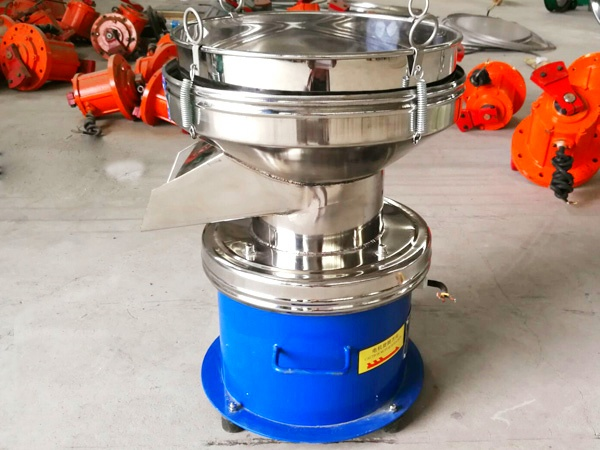
Best for: Impurity removal when hemp core powder is used in liquid additives or slurry filtration
Key features: Designed for liquid-solid separation; fine mesh with high filtration accuracy; suitable for screening viscous liquid and powder mixtures
Capacity: 200-5000 kg/h | Mesh Range: 20-400 mesh
Recommended for: Wet processing, liquid additive filtration, slurry applications
Video: Hemp Core Powder Vibrating Screen in Operation
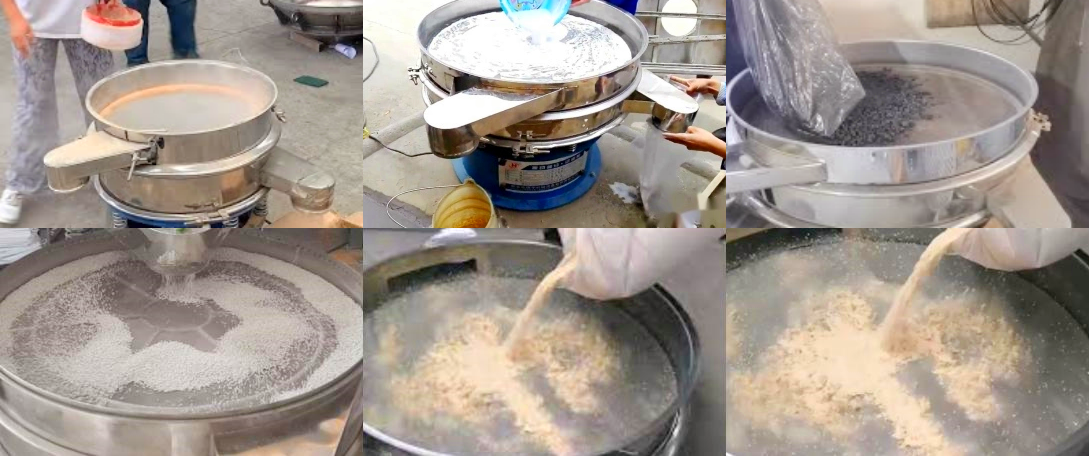
Video 1 Description: This demonstration shows the Dahan Machinery rotary vibrating screen processing hemp core powder. You can observe the 3D vibrating motion that moves material across the screen surface, with fine powder passing through the mesh and coarse particles being discharged from the side outlet. The equipment shown is a DH-1000 model with 3 screen decks (40, 80, and 120 mesh).
Video 2 Description: This video illustrates the multi-layer screening principle in detail. Hemp core powder enters from the top feed port, passes through screens of decreasing mesh sizes, and is separated into 4 distinct particle size fractions — demonstrating the equipment's capability for simultaneous multi-grade classification.
Working Principle of Hemp Core Powder Vibrating Screen
The hemp core powder vibrating screen typically adopts the working principle of the rotary vibrating screen, with a vertical vibrating motor serving as the excitation source. The eccentric weights at the upper and lower ends of the motor convert rotational motion into horizontal, vertical, and inclined three-dimensional motion, which is transmitted to the screen surface.
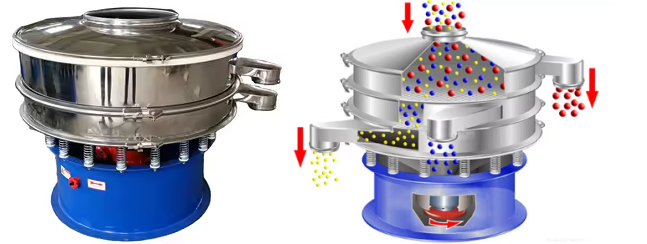
Hemp core powder enters the equipment through the feed port and moves in a complex spiral path across the screen surface — up, down, left, and right simultaneously. Depending on screening requirements, the material passes through 1-5 screening layers with screens of different mesh sizes.
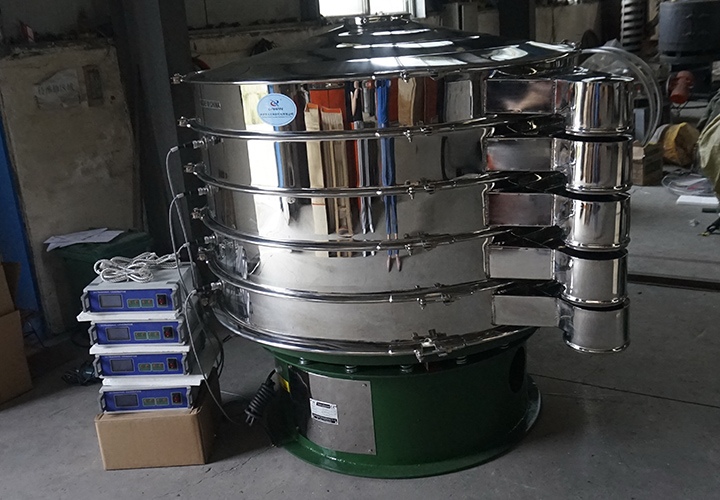
The screen cleaning device (bouncing balls or ultrasonic system) under each screen layer continuously impacts the screen, preventing material buildup and ensuring smooth screening. Materials of different particle sizes either pass through the corresponding mesh screens or are discharged through designated outlets at each layer, achieving the final screening or filtration purpose.
Structure of Hemp Core Powder Vibrating Screen
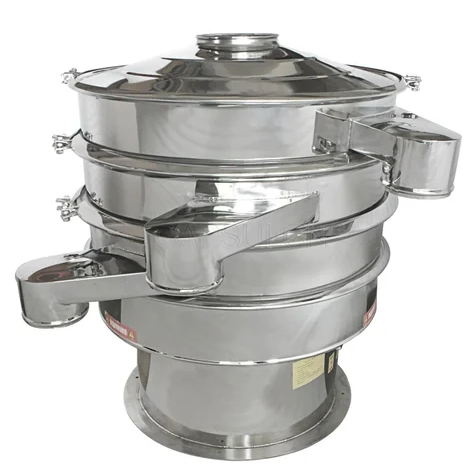
The hemp core powder vibrating screen mostly adopts circular or linear vibrating screen configurations. The structure may vary slightly based on different process requirements, but the basic components typically include:
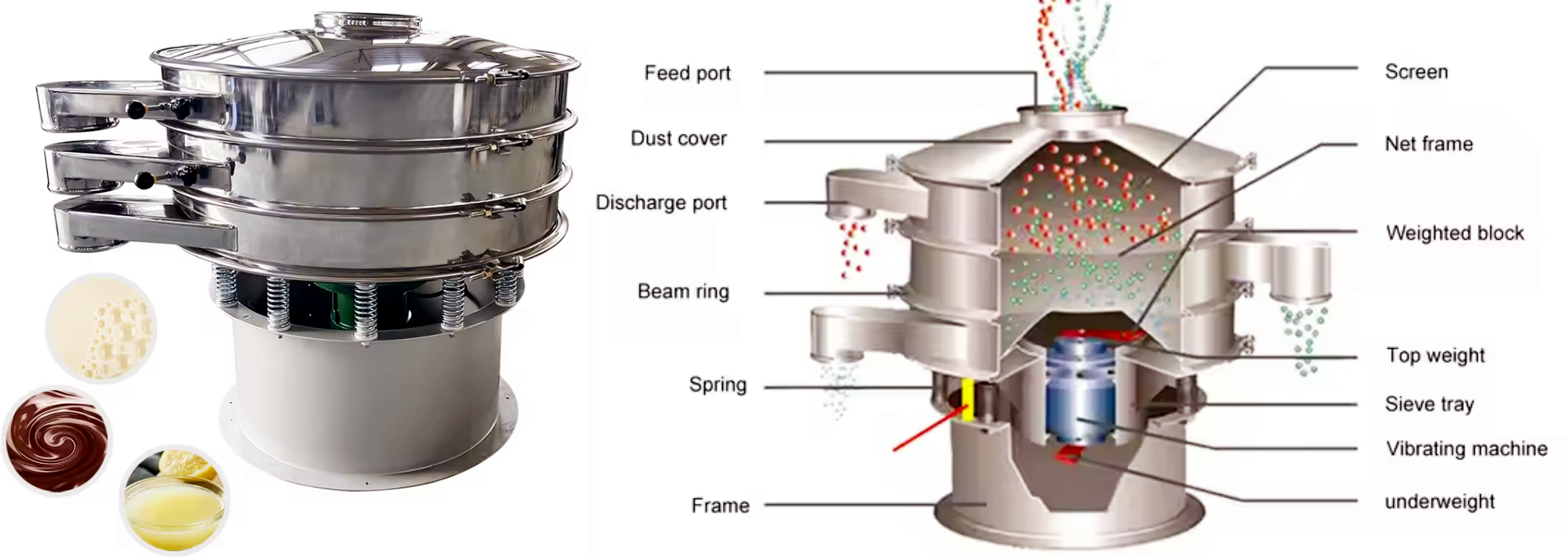
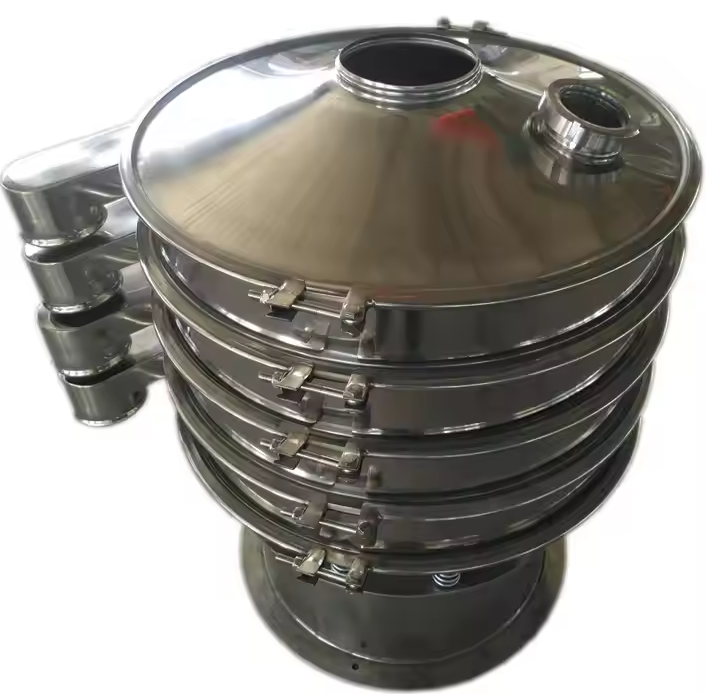
Screen box: Composed of upper cover, middle cylinder, and lower base. Multiple screen layers (1-3 layers) are installed inside to achieve coarse and fine classification
Screen system: Uses fine mesh stainless steel woven mesh (such as 60-200 mesh), suitable for the particle size range of hemp core powder. For ultra-fine applications, electroformed screens with precise hole shapes and high open area ratios are recommended
Vibration motor: Provides exciting force to generate three-dimensional or linear vibration, controlling the movement trajectory of the material
Base and shock absorption system: The entire machine is connected to the base through rubber springs or spiral springs, providing support and vibration damping
Discharge ports and collection system: Equipped with multiple discharge ports for discharging coarse and fine powder after grading and screening
Key Features of Hemp Core Powder Vibrating Screen
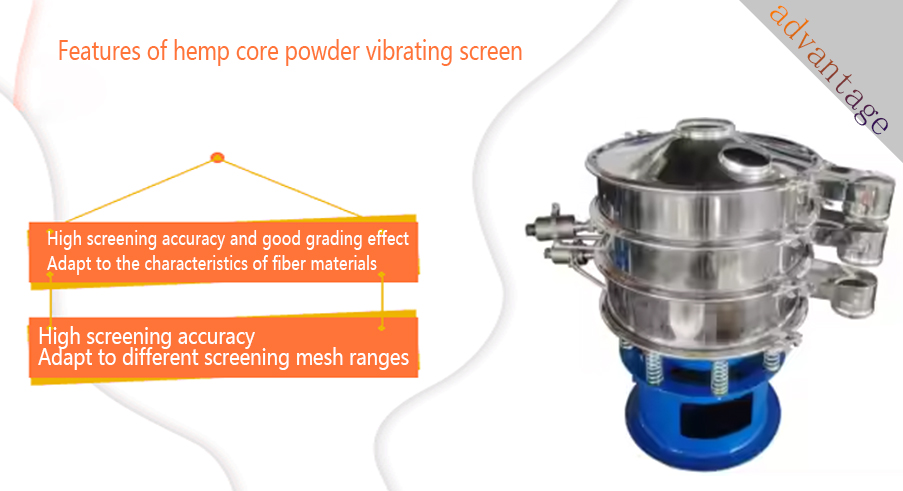
High Screening Accuracy & Multi-Grade Classification: Configurable with multiple screen layers for simultaneous grading of 2-4 materials of different particle sizes. Screening particle size can be controlled within 80-200 mesh, suitable for most fiber powder applications.
Fiber Material Adaptability: Given the characteristics of hemp core powder — lightweight, prone to entanglement, and prone to dusting — the equipment is often equipped with an ultrasonic vibration device to solve fine powder sticking and screen blinding issues, significantly improving screening efficiency.
Anti-Blinding Technology: Multiple anti-blinding solutions are available: bouncing ball cleaning systems under each screen deck that continuously impact the screen surface; ultrasonic systems that generate high-frequency vibrations to break material agglomeration and offset electrostatic adsorption; and electroformed screens with smooth, burr-free holes that fundamentally reduce clogging risk.
High Screening Precision: Through reasonable structural design and parameter adjustment, the equipment achieves accurate classification of hemp core powder, minimizing mixing of coarse particles in fine powder or fine particles in coarse powder.
Flexible Mesh Configuration: Choose combinations of screens with different meshes based on specific application requirements — from coarse screens (such as 20 mesh) to fine screens (100 mesh or higher) — all in a single equipment.
Easy Maintenance & Quick Screen Change: Designed for operator convenience with quick-release screen frames, easy-access cleaning ports, and minimal downtime for screen replacement — typically 10-15 minutes for a complete screen change.
Hemp Core Powder Vibrating Screen Specifications & Model Selection Guide

How to select the right model for your production needs:
- DH-600 / DH-800: Ideal for small-batch production, R&D laboratories, or pilot plants. Capacity up to 500kg/h.
- DH-1000 / DH-1200: Most popular for medium-scale production. Balances capacity (500-2000kg/h) with floor space efficiency.
- DH-1500 / DH-1800: Recommended for large-scale industrial production requiring high throughput (2000-5000kg/h).
- DH-2000: Maximum capacity model for high-volume operations processing 5000+ kg/h.
|
Type No. |
DH-600 |
DH-800 |
DH-1000 |
DH-1200 |
DH-1500 |
DH-1800 |
DH-2000 |
|
Diameter mm |
Φ600 |
Φ800 |
Φ1000 |
Φ1200 |
Φ1500 |
Φ1800 |
Φ2000 |
|
Screen area m² |
0.24 |
0.45 |
0.67 |
1.0 |
1.6 |
2.43 |
3.01 |
|
Screen specification (mesh) |
2-500 |
||||||
|
Feed particle size mm |
<Φ10 |
<Φ15 |
<Φ20 |
<Φ30 |
<Φ30 |
<Φ30 |
<Φ30 |
|
Vibration times rpm |
1500 |
1500 |
1500 |
1500 |
1500 |
1500 |
1500 |
|
Effective screen surface diameter mm |
Φ560 |
Φ760 |
Φ930 |
Φ1130 |
Φ1430 |
Φ1760 |
Φ1960 |
|
Number of decks |
1-5 |
||||||
|
Power Kw |
0.25 |
0.55 |
0.75 |
1.1 |
1.5 |
2.2 |
3 |
Applications of Hemp Core Powder Vibrating Screen Across Industries
Papermaking Industry: Hemp core powder is one of the important raw materials for papermaking. The vibrating screen screens hemp core powder, removing impurities and unqualified particles to improve paper quality and performance. The organosolv process has been shown to effectively upgrade hemp core for papermaking purposes.
Textile Industry: In hemp fiber processing, the vibrating screen grades and screens hemp core powder, providing raw materials that meet requirements for subsequent textile processes. Hemp fibers contain a higher concentration of cellulose compared to wood, with substantially lower lignin content, making them valuable for textile applications.
Chemical Industry: Hemp core powder serves as an additive or raw material for certain chemical products. The vibrating screen accurately screens it to ensure quality and stability of chemical products.
Construction & Building Materials: The woody inner core (hurd) feeds into hempcrete, animal bedding, absorbents, pulp, and biocomposite fillers. The hemp building products market is projected to hit $65.6 billion by 2032. Hemp shives are used as filler in lime-based composites, providing excellent hygrothermal properties.
Hemp-Based Food & Nutraceuticals: The global hemp-based food market reached $1.96 billion in 2025, projected to grow at 12.43% CAGR through 2034. Hemp protein powder — requiring 80-200 mesh screening — is the fastest-growing segment with an 11.93% CAGR.
Other Industries: The equipment is also applicable to pharmaceutical, animal feed, and building materials industries for screening and grading similar powdered materials.
Hemp Core Powder Vibrating Screen Manufacturer — Dahan Machinery
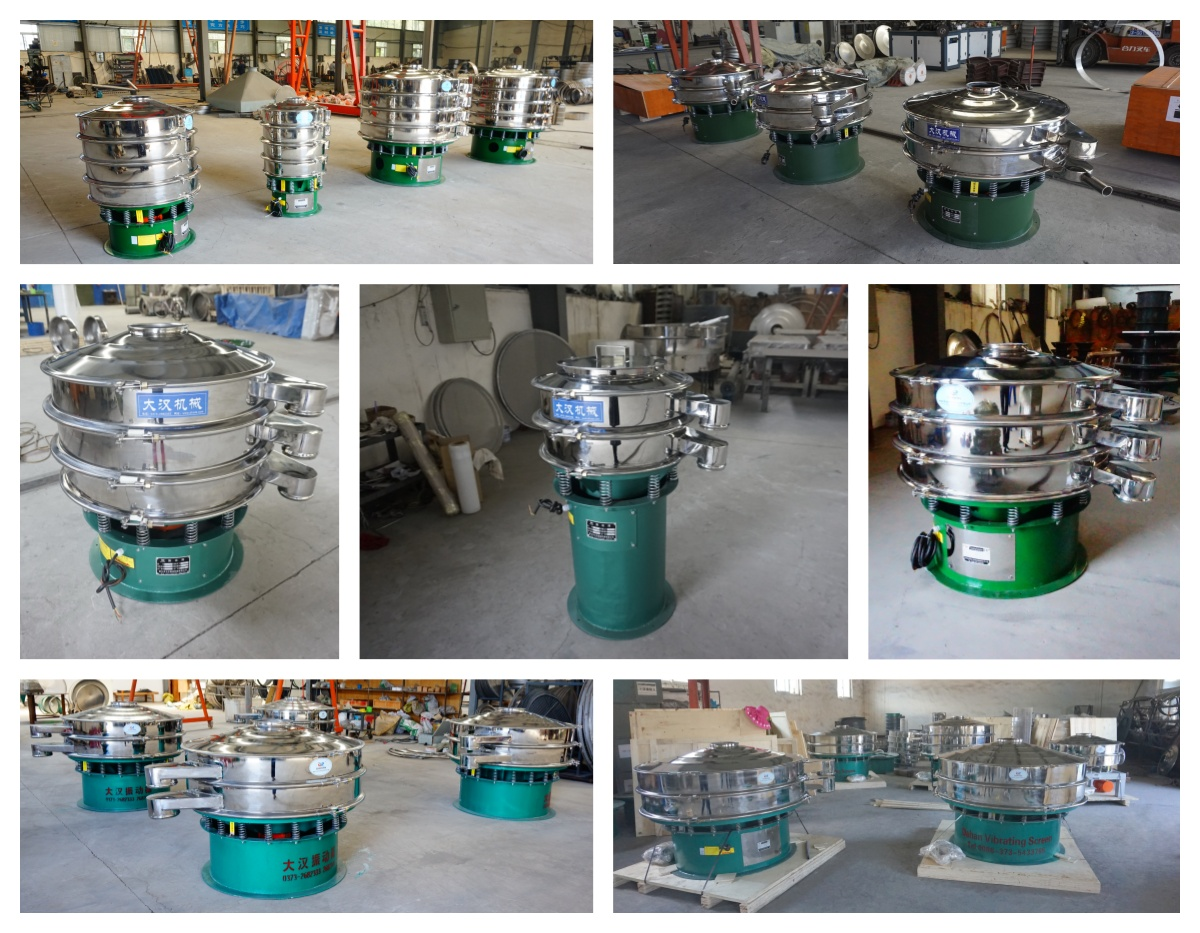
Dahan Machinery is a leading manufacturer of vibration screening equipment with a well-established reputation in China and international markets. We produce various types of vibrating screens, including circular vibrating screens, linear vibrating screens, rotary vibrating screens, and specialized screens for challenging materials like hemp core powder. Our equipment is widely used across chemical, food, pharmaceutical, mining, and agricultural processing industries.
Why choose Dahan Machinery for your hemp core powder screening needs?
- Industry Experience: 15+ years of manufacturing expertise in vibration screening technology
- Quality Certifications: ISO 9001:2015 certified; CE certified equipment available
- Custom Engineering: Tailored solutions for your specific hemp core powder characteristics and production requirements
- Global Support: Export to 50+ countries with responsive technical support and spare parts availability
- Factory Direct Pricing: Competitive pricing from $800-$4,500 per set, depending on model and configuration
To get the right recommendation for your application, please consider and share:
- What is the purpose of the hemp core powder you need to screen? (Industrial use, food-grade, construction, etc.)
- What particle size range of hemp core powder do you want to screen out?
- What are your requirements for the output/capacity of the vibrating screen?
- Do you have special requirements for material (stainless steel 304/316L), number of layers, or dust control?
With more specific information, our engineering team can provide tailored recommendations and quotations. Contact us today for a free consultation →
Frequently Asked Questions About Hemp Core Powder Vibrating Screen
What mesh size is best for hemp core powder screening?
The optimal mesh size depends on your application. For general industrial use, 40-80 mesh is common. For fine powder applications like paper pulp or biocomposites, 100-200 mesh is recommended. For ultra-fine hemp protein powder, 200-400 mesh may be required.
How to prevent screen blinding when screening hemp core powder?
Hemp core powder's fibrous and lightweight nature can cause screen blinding. Solutions include: ultrasonic vibration systems that generate high-frequency vibrations to keep mesh clear; bouncing ball cleaning systems; selecting electroformed screens with smooth, burr-free holes; and regular maintenance cleaning.
Can I use one vibrating screen for both coarse and fine hemp core powder?
Yes. Multi-layer vibrating screens can be equipped with different mesh sizes on each deck — for example, 20-mesh coarse screen on top, 40-mesh and 80-mesh middle screens, and 100+ mesh fine screen at the bottom — allowing simultaneous separation of multiple particle sizes in a single pass.
What industries use hemp core powder vibrating screen?
Key industries include: papermaking (hemp core powder as pulp raw material), textile (fiber processing), chemical (additives and fillers), construction (hempcrete and biocomposites), animal feed (nutritional additives), and the rapidly growing hemp-based food industry.
How do I choose the right vibrating screen model for my hemp core powder production?
Consider four factors: 1) Target particle size — determines mesh range; 2) Required throughput — determines model size; 3) Material characteristics — moisture, fiber content, flowability; 4) Application requirements — purity, dust control, multi-grade separation. Contact our engineers for a free consultation.
Get a Free Quote for Your Hemp Core Powder Screening Solution
Tell us your requirements and our engineering team will recommend the best model for your production line.
-
How to Apply Powder Coating Ultrasonic Sieving Machine
Powder coating ultrasonic sieving machine is a fine powder sieving machine with relatively perfect te ...
-
Sunflower seeds screening machine
Sunflower seed screening machine, also known as sunflower seed vibrating screen or separator, is a special equipment ...
-
Centrifugal screening machine
Centrifugal screening machine is designed and produced for screening problems such as light materials, easy agglomeration ...
-
Sweet potato powder screening machine
The Sweet potato powder screening machine effectively screens, filters and removes sweet potato starch to ensure the quality ...

Email:
sale@xxdahan.com
WhatsApp:
+86 15236742901
Add:
1000m West of Forest Park,Yanjin County,Xinxiang City,Henan Province,China.